

Ok, so the headline is a joke. Sort of.
I published my last post exactly 1 month ago. That’s my longest hiatus since I started Uncharted Territory back in August of 2024. In fact, I don’t think I’ve ever missed consecutive weeks until now.
Life got in the way (in a good way). The first week of March was given over to a team-wide offsite, which we spent outlining exactly how we’re transforming Gradient Works into an agent-first company. (More on that in a later post.)
I spent the last two weeks in Japan with my family. It was—largely—a 10th birthday present for my daughter who’s fascinated with the country.1 Over 10 days, we visited Tokyo, Kyoto and Osaka. Very little of it had anything to do with B2B sales.
Or did it?
History, spirituality and… business?
Sales has, of course, existed since humans first started hanging out in groups and realized that it was often easier to trade stuff than constantly bash each other over the head. It took quite a while for that to get organized into something resembling our modern day ideas of companies producing goods and services for specific markets.
Japan, however, has an incredibly long history of commercial activity that bears a surprising resemblance to our modern day ideas. According to a Bank of Korea study, more than half of the oldest companies in the world are located in Japan, including the five oldest. The oldest, Kongō Gumi, was founded in 578. A little perspective: when Thomas Jefferson was drafting the Declaration of Independence, they had already been building temples and shrines for 1,198 years.
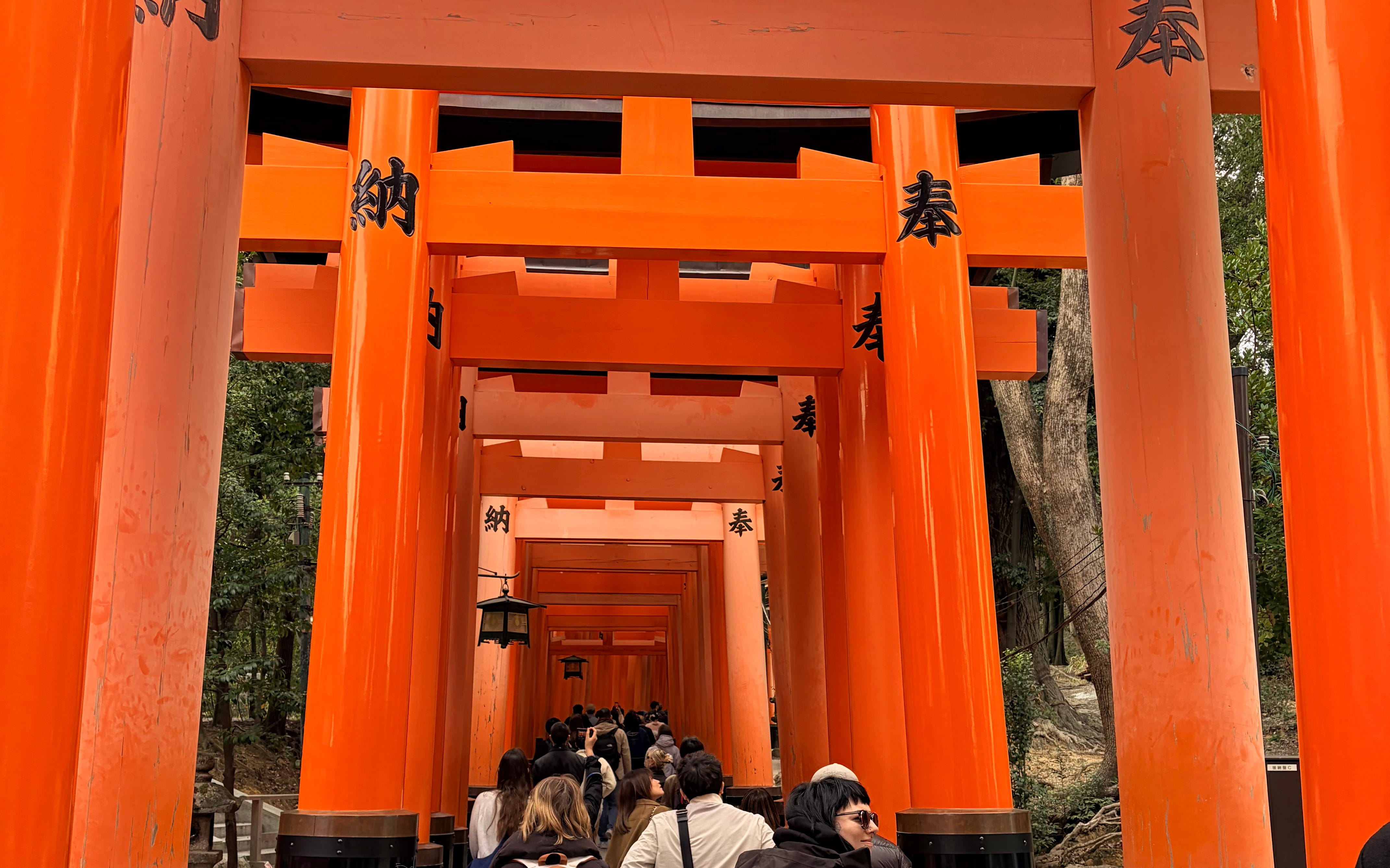
I’d read about this company at some point and it briefly popped into my mind a few days into our trip as we visited the Fushimi Inari shrine in Kyoto—the most important Shinto shrine devoted to the Inari kami2. I don’t think Kongō Gumi had anything to do with this particular shrine, but the first buildings were built in 711.
Today, you arrive there by getting off at the thoroughly modern train station. You immediately pass through a torii (the first of many, more on that in a moment) and head up a gently sloping street filled with vendors serving both the tourists and the faithful as they wind their way up to the shrine itself. You can buy everything from engraved chopsticks to fox trinkets to cheese waffles to barbecued eel. We were there on a random Sunday and it was packed.
The shops continue from the train station all the way up to the grounds surrounding the first shrine. Not knowing what to expect, I was a little taken aback at how freely the commercial and the sacred mixed together. If I’d done my homework, I wouldn’t have been surprised—Inari is the kami of merchants and prosperity.
Fushimi Inari is famous for its 10,000 torii. Several hundred of these gates are set close together, forming a tunnel (the Senbon Torii3) through the forest up the slope of Inariyama. The combination of the setting and the surrounding forest still somehow made it feel hushed and solemn despite the crowds.
This tunnel is yet another example of the mixing of the spiritual, the commercial and the historical that seems somewhat unique to Japan. Each of these torii were donated by a business, a practice that began in the 1600s.
So does this actually have anything to do with B2B sales?
Customer experience is a craft
I’m not suggesting the lesson is we in the US should quite literally enshrine business as a spiritual pursuit. However, I do think this unique combination may contribute to something else I noticed in Japan: a level of care and depth to commercial experiences that we really can learn from.
I’ll offer a quick caveat: my 10 days as a tourist in Japan don’t represent the reality of the people and their culture. Furthermore, nearly everyone I encountered there was in the business of hospitality—explicitly aiming to provide quality experiences. This is not an unbiased sample.
That, however, doesn’t change the fact that so many people we interacted with routinely went above and beyond to make our experiences fantastic. Here are a few highlights:
After a particularly long day of travel, we tried a local hamburger restaurant4 in Kyoto. As we were leaving, the wait staff literally ran after us to make sure we got stickers.
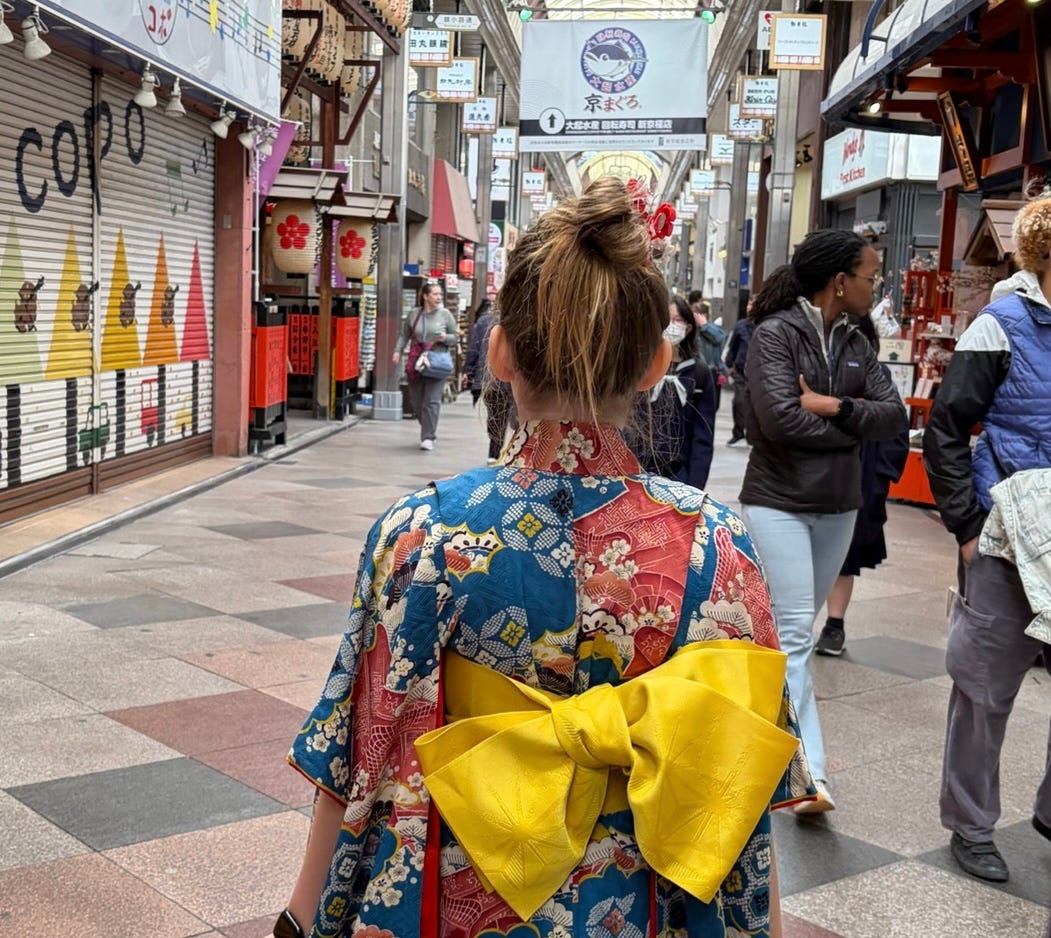
The staff at a vintage kimono shop we stumbled across absolutely fawned over my daughter, letting her try on lots of different kimonos to find the perfect one, styled her hair and did a full-blown photoshoot. She was over the moon.
We randomly stopped into a shop in Kyoto selling wooden crafts (we have a lot of woodworkers in our lives). The elderly shop owner—who didn’t appear to speak a word of English—made a flower out of thinly shaved wooden paper5 for our daughter.
On our last night in Tokyo, the two amazing front desk staff at our hotel spent all morning finding us a car service to the airport so we could spend our last few hours in Japan wandering the city. When we got back, the car was waiting for us, already loaded with our stuff.
Now, what’s interesting about these experiences is that each involved plenty of GTM technology. We wouldn’t have found the restaurant or the hotel without their excellent SEO. The staff at the kimono shop asked to post some pics on Instagram to help with social exposure. Even the old carpenter managed his inventory on an iPad.
But the aspects that make them more than a simple commercial transaction—that make them literally remarkable—all came from humans who took the care to make the experience meaningful.
Even though I was 14 hours ahead, I’ll admit to checking in on LinkedIn periodically. My entire feed was devoted to AI and how it’s transforming GTM. In the past there were parts of every customer experience that simply couldn’t be turned over to a machine—whether in 578 or 2026. In the future, that will be a choice. It won’t be a matter of can’t, it’ll be a matter of should. We should choose wisely.
A few additional observations
Japanese has 3 alphabets. Hiragana and Katakana are fairly straightforward to learn mnemonically (thanks Dr. Moku). By the time I left, I could at least sound out a bunch of words and understand the difference between native Japanese and loanwords. Kanji, on the other hand, is intimidating. I basically got as far as recognizing Tokyo (東京).
The egg salad sandwiches at 7-Eleven are as good as advertised. Let’s just say I had quite a few. I love sushi, wagyu, and enjoy a good katsu, but I don’t love broths and soupy noodles like some people do. Every so often I needed a hit of that perfectly soft white bread and creamy kewpie mayo as an alternative.
The trains really do run perfectly on time—we took a lot (both bullet and otherwise) and were never even a second late.
Food was much cheaper than I expected. Inflation got us good here in the US.
If you saw a large poorly dressed white guy, you could be sure he was American or Australian. You just had to wait for him to talk to figure out which.
A good futon mattress is astonishingly comfortable.
We had originally planned a huge international trip for the summer of 2020. That… didn’t work out as planned. In the end I’m glad for two reasons. One, we founded Gradient Works instead. Two, my daughter would have been too young to really appreciate it.
I think I’ve got this right, but please let me know if I’m misstating anything here.
Literally “1,000 gates”, though apparently it’s “only” about 800.
Don’t judge.