
The Composable GTM Ecosystem, Part 1
An new approach to the GTM tech stack takes shape.

Something’s happening to the GTM tech stack. Yes, it’s AI, but it’s not just AI. We may be on the cusp of a different kind of architecture for GTM tech—one built less on monolithic platforms and instead composed of best-of-breed components. This is the first of two posts investigating that shift.
The state of the stack
For the last 16 years, Scott Brinker has published a graphic of what he calls “the marketing technology landscape”. Scott brands this the MartechMap, but it really includes just about anything related to GTM, making it the best proxy we have for the overall GTM technology ecosystem.
The map started life in 2011 as a slide with 150 product logos. This seemed like a lot at the time. By 2025, it looked like this:
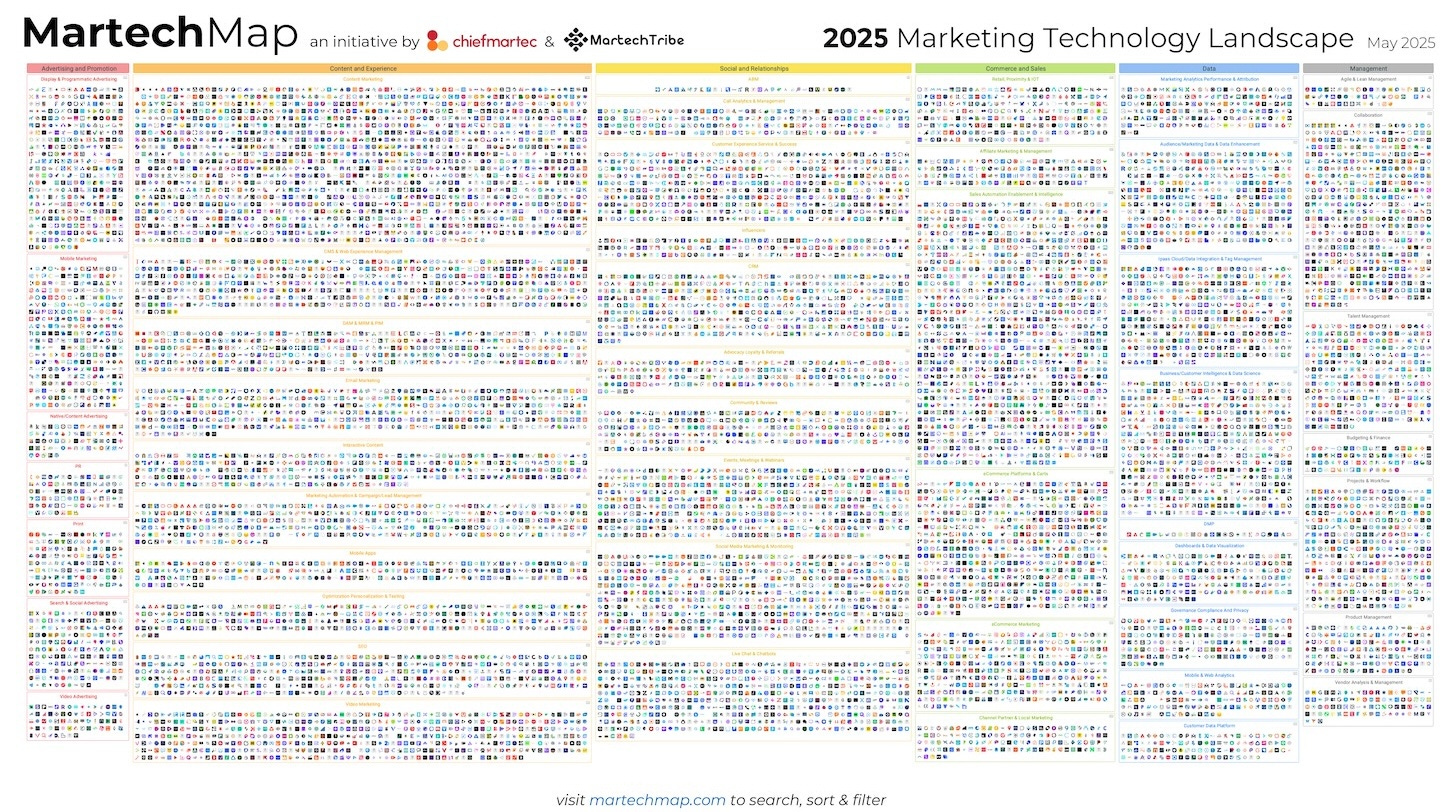
Those tiny colored pixels are actually product logos representing 15,384 tech products. (Go here to zoom in.) If you’re keeping score at home, the number of market participants has grown at a 39.2% CAGR since 2011. I’ve said before that the supply of software products is likely outpacing demand. I’d say this data point supports that thesis.1
No company uses all these products at once, so they pick and choose different products to form their tech “stack”. That makes sense. A “stack” sounds like an orderly arrangement, pieces fitting neatly together, lower layers supporting higher layers, everything in its right place.
Anyone who’s actually supported the unholy amalgamation of tech that represent the modern “GTM tech stack” knows this orderly analogy is… generous. It’s less a stack than a pile of overlapping functionality, spotty integrations and data silos aplenty.
There is some structure, though. A few pieces of tech sit at the center, while others roam the periphery. In B2B, one piece of technology tends to be the center of it all: the CRM.
Threats to CRM-centrism
On June 22nd, 1633 Galileo was found guilty of heresy by the Roman Inquisition2 because he argued for heliocentrism—that the Earth orbited the Sun. The Catholic Church, unfortunately, felt pretty confident God wanted Earth at the center of the universe (geocentrism). As punishment for thinking otherwise, they made Galileo live in his (quite lovely) villa under house arrest for the last 9 years of his life.3
It would be almost 200 years before the church fully came around to heliocentrism. For a long time, nobody got fired for choosing geocentrism even if it wasn’t actually correct. It was a very gradual diffusion from “crazy idea” to “matches observations” to “we know why this works” to “generally accepted”.
These shifts in worldview are sometimes only obvious in hindsight. That said, it’s possible we’re seeing the beginnings of something similar in the GTM world. For the last 20+ years, B2B GTM tech has been CRM-centric. That may be changing.
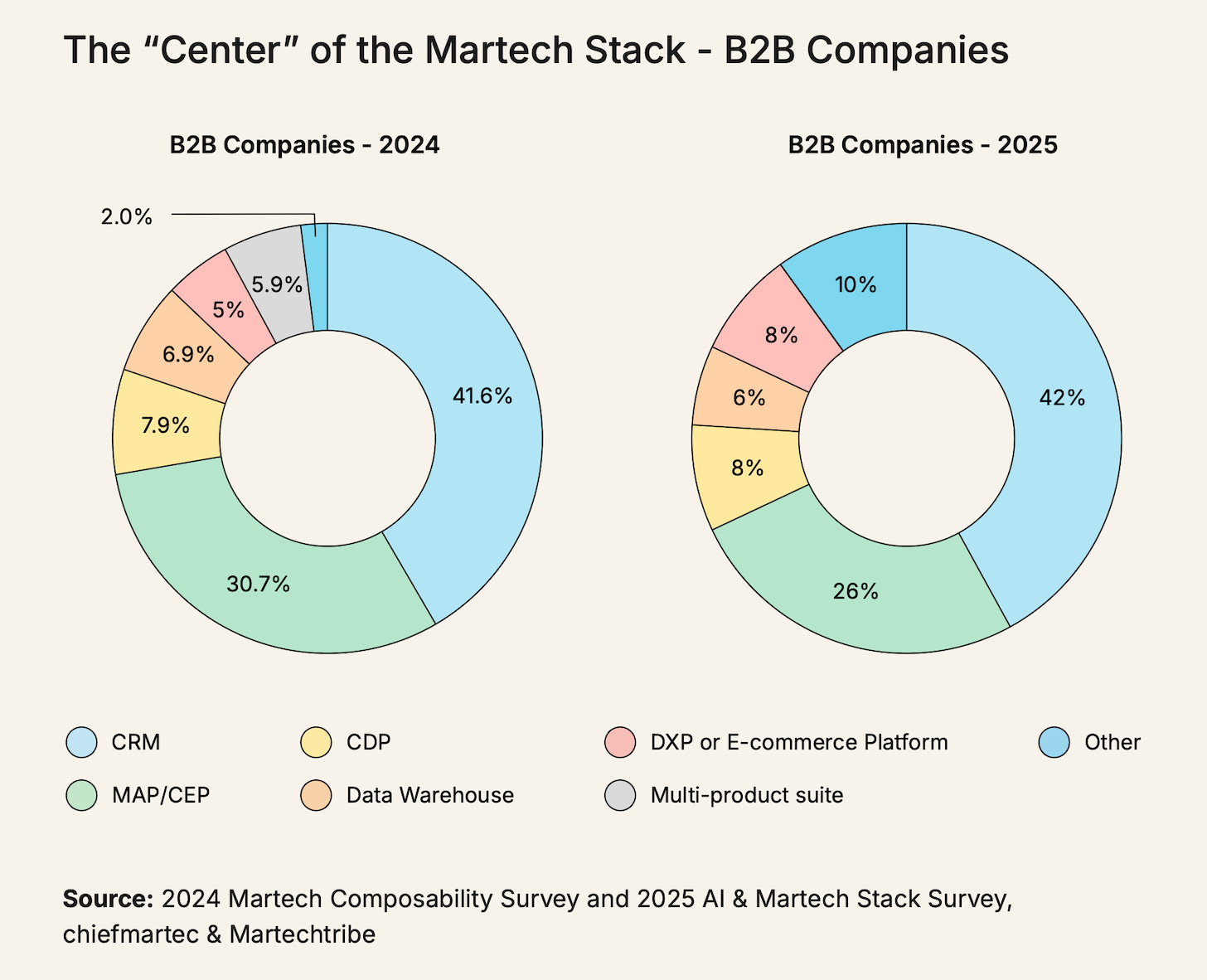
At first glance, nothing about this data seems to threaten CRM-centrism. In fact, slightly more respondents said the CRM was at the center of their stack in 2025 than in 2024. But, something kind of weird is happening. The “Other” category grew 5x. It’s possible a different approach is brewing.
The markets provide some other evidence of uncertainty about CRM dominance.
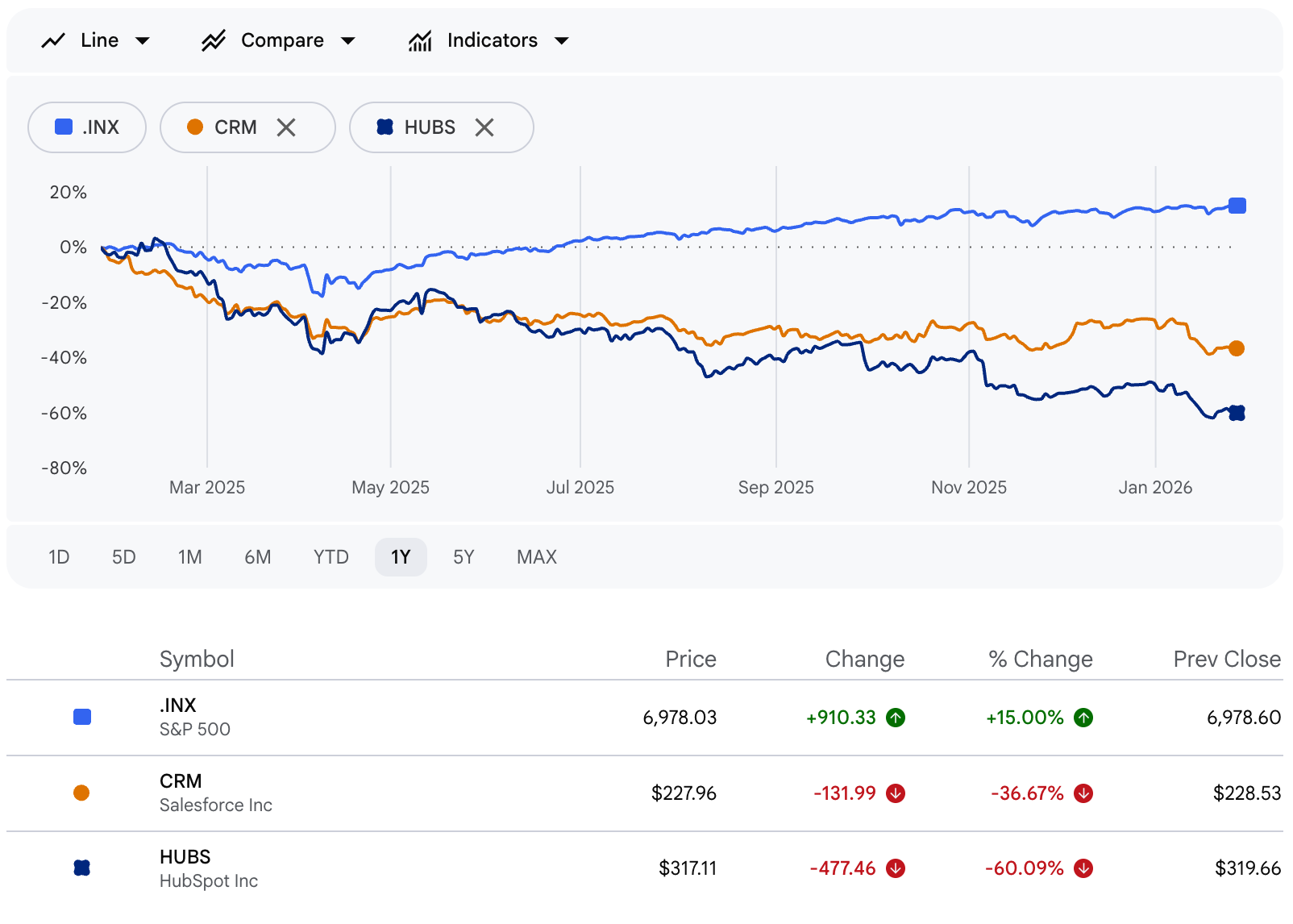
It’s been a rough 12 months to be a CRM vendor. Salesforce’s stock is down 37% and HubSpot is down 60% over that time. Meanwhile, the S&P 500 is up 15%. Something’s got investors spooked.
I’ve seen some folks predict the death of CRM because people will just “vibe code their own CRM”. I believe that’s nothing more than a clickbait argument that needs to be put on the shelf alongside the perennial LinkedIn “death of outbound” posts. If we do see a real shift away from CRM-centrism, I think the reasons will be due to a larger shift in how GTM—and technology generally—work.
From CRM-centrism to composability
CRMs have historically competed across three dimensions:
Data - CRMs aim to be the system of record. Once they become the source of truth for all your customer data, they’re nearly impossible to rip out.
Workflows - CRMs aim to be the system of action. Since they have all your data, they might as well also host the business processes that use and manipulate that data.
User Interface - CRMs aim to be the “pane of glass” where the humans on the GTM team do their work.
Different CRMs emphasize different elements. Salesforce competes on depth of data and workflows. Sophisticated users get ample sharp tools with which to build custom solutions, while risking some bodily harm in the process. As for the UI, it can best be described as “designed by a team whose first and last experience with a computer was in 2005”.
HubSpot, on the other hand, emphasizes user experience. I’d say it’s…fine in that department—plenty of big friendly explanations sprinkled among the upsell CTAs. Its data and workflow capabilities have improved, but still frequently feel a bit like performing surgery while wearing mittens. Sure, your hands aren’t cold in that freezing operating room, but your patient might not wake up in the state you’re hoping for.
Regardless of the emphasis, the big question is whether this bundle of capabilities is actually best delivered as one product. In a world where the majority of GTM is human-centric, this makes sense. Business processes need data combined with a human in the loop. Workflows need to be close to the data. Humans need interfaces to that data and those workflows. It all make sense as One Thing.
But today the grand compromise that created the CRM is breaking down.
There have been major changes at the level of basic technology infrastructure since the emergence of the CRM category. Tools and techniques for managing data, connecting systems and building workflows are cheap and commonplace. When Salesforce began, every one of those things was capital intensive and difficult.
All of those technical changes happened before the emergence of AI. AI makes it possible to remove the final thing holding CRM-centrism together: the requirement to always have a human in the loop.
As these shifts play out, there’s less imperative to bundle data, workflow and UI into a single product. Instead, it becomes possible to compose a solution from best-of-breed parts. This isn’t just “vibe code a CRM from scratch”. Instead we can start to see an industry-wide shift towards well-defined components that can be combined together to build a GTM solution.
This has long been the case in developer-heavy ecosystems (e.g. DevOps and data analytics), but it’s also common in parts of GTM-adjacent tech ecosystems like e-commerce and content management.4 It’s now standard procedure to compose best-of-breed components together to build solutions in those industries.
The same may be true of GTM. While I’m skeptical of the long-term viability of the GTM Engineer role, most of what GTMEs do today involves putting composability into practice. They use tools like Clay and n8n to orchestrate workflows using API-enabled services that do things like retrieve firmographic data, enrich contacts, scrape websites, send emails, etc.
In this world, the locus of competition in GTM tech shifts from closed platforms that present a single “pane of glass” for human users (e.g. CRMs) to a distributed set of relatively open components that can easily interoperate with each other via APIs. This shift creates promise and peril for both GTM teams and GTM tech vendors. How that world might evolve will be the subject of Part 2.
Of course, I’m the CEO of a GTM technology company. I was dumb enough to jump into this mess back in 2020 back when there were “only” around 8,000 products. When you’ve got conviction about something, you gotta jump in. But that’s another story…
Not to be confused with the Spanish version.
Certainly beats being executed on some kind of medieval torture device.
The MACH alliance is a good example of this shift.