


I spent last week in NYC, getting in late enough on Monday to miss the Nor’easter. I spent the majority of my work week at the Pavilion GTM 2026 conference talking (mostly) about AI in a glassy, modernist event space (literally called The Glasshouse).
By Friday evening, however, I was looking at a 571-year-old Gutenberg Bible in J.P. Morgan’s opulent three-story library at The Morgan—the first stop on a brief tourist weekend with my wife and daughter.

Being the history, technology and GTM nerd that I am, the juxtaposition of today’s transformative technology with that of half a millennium ago got me thinking.
Gutenberg’s printing press was a disruptive innovation par excellence. A new technology made something that had been expensive—reproducing the written word—become cheap. That revealed entirely new market dynamics. It turned out there was a lot of untapped demand for written information if it could be supplied at a lower cost. That encouraged more written words.
Fast forward to 2026 and here we both are: me writing this newsletter in Austin, TX and you reading it anywhere in the world. Global distribution, completely free. No literate monks required.1 Quite the revolution.
We’re still in the early days of the Agentic AI revolution. We don’t have the benefit of 571 years of hindsight to know how it’s going to turn out, but we can see the potential. Whereas the printing press made it possible to reproduce knowledge en masse, agents make it possible to do any kind of knowledge work—consuming information, interpreting it, acting on it, and producing more information—at a scale that boggles the mind.
But that’s enough waxing poetic about technological revolutions. We know we’re living in a world that’s being massively impacted by AI. So how were the revenue operators at GTM 2026 responding?
Anything is possible, so everything’s the same
Thanks to AI, it’s never been cheaper and easier to build software. The software engineering monks with their secret linguistic knowledge and complex production processes have been well and truly disrupted by coding agents. In that way, it’s the 15th century all over again.
Only not quite. That analogy misses an additional nuance in the current situation. We’re increasingly using coding agents to write software to run… other agents.
While Gutenberg made books orders of magnitude cheaper to reproduce, someone still had to write the words. Those didn’t change to suit the reader.2 Software was that way as well. Agents are different. They are, essentially, software that writes itself based on the user’s desired task. When everyone is building agents, and agents are expected to do whatever the user needs, then is everyone just ultimately building the same thing?
It sure looked that way from the complimentary bar in The Glasshouse that sat at the center of the exhibitor space. The bar was sponsored, if I recall correctly, by AirOps, the AI discovery platform that uses agents to write content that helps other agents discover your product… which is also probably agents.
In one conversation after another, the difficulty of telling all the vendors apart came up—even those that used to have clearly distinct value propositions. Outreach, the once dominant sales engagement platform, is now an “agentic AI platform for revenue teams.” Nooks, the currently dominant parallel dialer, is now “revenue infrastructure for reps and agents.” Storylane, an early demo platform, now offers AI SDRs.3
Now, I prefer data over anecdote so I (naturally) used Claude to review all 63 GTM 2026 sponsors after I got back. Of those, I looked at 52 software vendors (i.e., not services, data providers or recruiters). Here’s what I found:
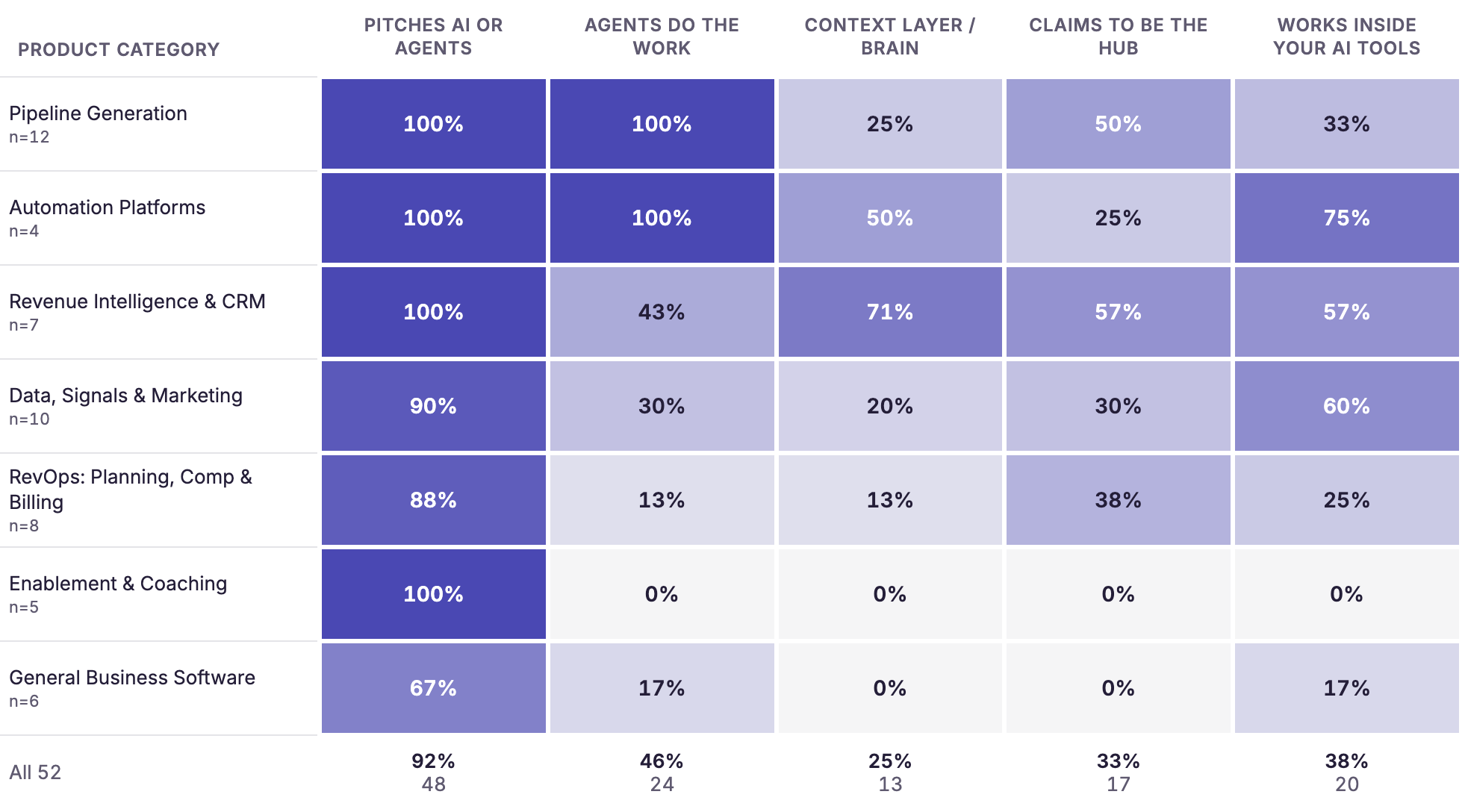
The AI pitch is essentially universal. The other pitches span categories as well. Nearly half of all vendors claim they have agents that will do work for you, a third of them want to be the central “hub” for all your GTM, and a quarter of them are trying to provide a context layer.
There is some differentiation. Clearly the Revenue Intelligence category competes more on the context layer while the Pipeline Generation and Automation vendors compete more on agents. But overall, this matrix gets pretty blurry everywhere aside from the Enablement and General Business categories.
GTM tech has always had a lot of overlapping vendors but I’m not sure it’s ever been this bad before. If you’re looking at tech for your team and feeling a little confused, there’s a good reason for that.
However, I doubt GTM tech is the only space that looks this way. Every other software category is starting to see this same kind of convergence around agents that can seemingly do anything. That presents a problem for GTM leaders. We’ve never had more capabilities to offer customers. The same goes for our competitors. Buyers are facing a tsunami of overlapping innovation from vendors.
As GTM leaders, we’re fighting a two-front war to 1) differentiate our capabilities and 2) drive adoption of what is still novel technology. And that’s where my favorite session from GTM 2026 comes in.
Crossing the chasm with quadrants
Geoffrey Moore wrote Crossing the Chasm, a book I’m embarrassed to say I’ve never actually read—despite getting many recommendations over the years from smart folks.4
That said, I feel like I’ve absorbed most of it by osmosis. Readers of a certain age like yours truly (i.e., those involved in tech and startups at any point between 1990 and 2010) are guaranteed to have encountered its concepts. If you’ve ever heard anyone talk about diffusion of innovation, early adopters, or laggards as they relate to technology businesses, they’ve been influenced by Moore’s work.5
That’s why I was excited to settle in for his presentation on Day 2 of GTM 2026. He wasn’t there, however, to talk about Crossing the Chasm. Instead he presented his more recent work on “zones”. While he wrote his book Zone to Win in 2015, it turns out to be extremely relevant in 2026 to a room of GTM operators—most of whom are both AI buyers and sellers.
Before we get to his zones, let’s look at his concept of two types of risk:
Alpha - the risk of doing the wrong thing (acts of commission)
Beta - the risk of falling behind (acts of omission)
Taking a big chance on a new technology that goes south is Alpha risk. Missing out on a big new technology that changes everything is Beta risk.
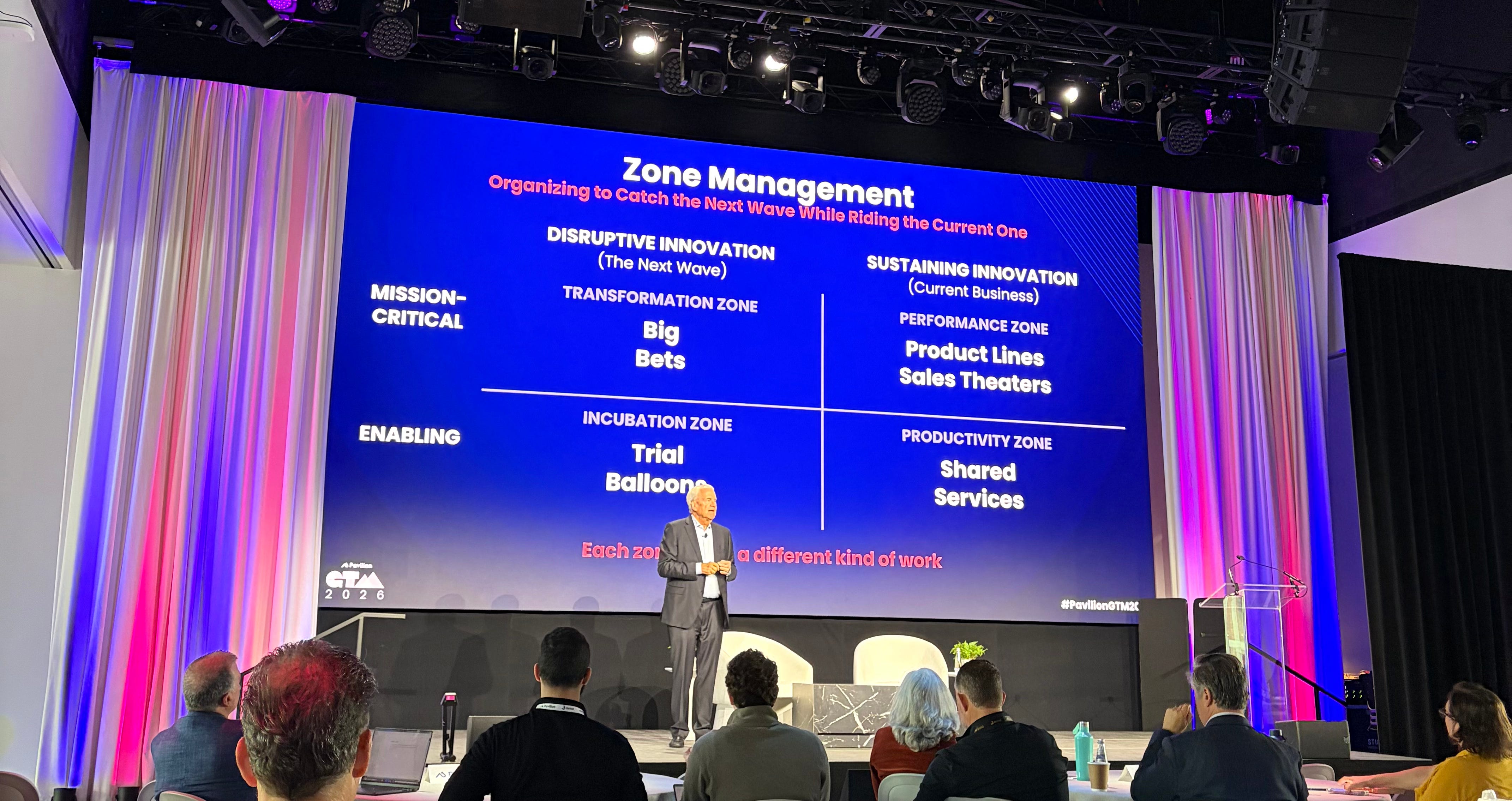
This feeds into the idea of 4 zones within an organization broken out across two dimensions:
Incubation Zone - where a disruptive innovation meets enabling investment (i.e., doesn’t directly generate revenue). This is, essentially, the lab. This lets companies try new things out without breaking anything. Alpha risk is low because the whole point is to try new things. The real problem is Beta risk—not trying enough new things and missing out on something that matters.
Productivity Zone - where a sustaining innovation meets enabling investment. This is where back-office functions like finance and support typically live. They’re conservative buyers trying to reduce time and costs. Alpha and Beta risks are both relatively low.
Performance Zone - where a sustaining innovation meets mission critical work (i.e., directly generates revenue). This is where a line-of-business or revenue owner adopts something new to get better outcomes. Assuming current performance is “good enough”, the risk of introducing something new and accidentally messing up a good thing means high Alpha risk and relatively low Beta risk.
Transformation Zone - where a disruptive innovation meets mission critical work. In this case there’s a senior buyer that’s decided to take a big gamble on a new thing to get a first-mover advantage. This has high Alpha and Beta risk and, as such, there are only a few visionaries that play here.6 Intercom’s early AI bet and transformation into Fin is an example of this zone in operation.
If you’re selling agents, you’re going to start out in the Incubation Zone because that’s where the risk is lowest. However, it’s easy to get stuck there in “pilot purgatory”. That’s a problem because the real money is in Performance and Transformation. Getting out of the Incubation Zone involves—you guessed it—crossing the chasm to those other zones.
While AI can seemingly do anything, Moore’s advice is to pick a narrow use case where there’s some kind of “trapped value” in a specific community and go all-in. Once you demonstrate success with a few companies, then word of mouth takes over and the pragmatic buyers in the Performance Zone will start to take notice.
If you look at a company like Clay, this is what they did with waterfall contact enrichment. It wasn’t until they went super narrow, helping lead gen agencies find better phone numbers, that they crossed the chasm into the Performance Zone. (Moore’s example was how Salesforce focused on industry-specific Agentforce use cases which is… less inspiring.)
Moore’s framework generally makes an implicit assumption: vendors are bringing specific technologies to buyers. AI is more foundational than that. It makes it possible to skip the vendor altogether7 and build custom solutions internally, but that doesn’t mean you always should. Which brings me to my last item from the conference.
Build vs buy vs partner
I was excited to listen to Sapan Parikh from Justworks present on their approach to building vs buying. I first met Sapan back in 2022 when he was a Sales Ops Manager. Now he’s Director, Revenue Strategy & Operations. I’ve also written a couple of articles before on the topic of build vs buy myself so I wanted to compare Sapan’s perspective with mine.
Sapan shared some of the tools they’ve built internally, including a forecasting system that they view as critical to the business. He also talked about how they’ve organized their team to be able to build effectively. Interestingly, it seemed to involve more centralization than the pod model used by Luxury Presence. It just goes to show that there are multiple ways to build.
One area where he really exposed a gap in my thinking is with partnering as an alternative to the build vs buy binary. I never even mentioned it in my previous articles!
Custom integrations used to be the domain of enterprise software and specialized SIs. However, AI has made software so much more malleable and inexpensive to produce that vendors are now much more willing to partner with customers to build solutions. This obviously coincides with the rise of the FDE—an area where my thinking has evolved a lot. I took several digs at forward deployed engineers in 2025 but then did a 180° and started an FDE agency alongside Gradient Works.
This kind of FDE work may be what’s necessary for a vendor to cross the internal chasm with a customer and get from pilot purgatory in the Incubation Zone to real utility (and revenue) in the Performance Zone.
Wrapping up
Overall this year’s GTM conference was more optimistic than the 2025 edition. There’s plenty of uncertainty but less fear. It’s clear there’s a huge transformation underway and where there’s change, there’s opportunity.
The real challenge is that I’m not sure we’ve ever had a technology as far-reaching and as flexible as Agentic AI. Part of the optimism comes from the collective feeling that we’ve been released from the invisible constraints of “software” and anything is possible.
That flexibility is a double-edged sword. We can now build anything, including other things—agents—that can essentially build anything. It’s very easy to lose sight of solving specific, valuable problems for real customers in the race to build the uber-software that’s the hands, the brain, and the hub for every use case. Unfortunately, that’s a recipe for staying firmly on this side of the chasm in pilot purgatory.
GTM operators have a specific responsibility in this regard. As the market-facing part of their organization, they need to listen carefully to customer needs and temper the agentic excess that can lead to building anything everywhere all at once.
After Geoffrey Moore gave his talk, he sat down with Sam Jacobs, CEO of Pavilion, for a Q&A. Sam asked him what’s different about this moment versus the previous 50 years of technology adoption. His answer: “Everybody says, ‘well this time it’s different’ and you have to be a little bit suspicious. That said… this time it’s different.”
I’m inclined to agree.
Maybe I could charge for an illuminated version of this newsletter, though.
Outreach and Nooks now have .ai TLDs. Storylane, at least, has kept its .io TLD.
He didn’t make all these terms up, but he packaged them in a way that seems to have made the ideas go from niche to widely adopted in the tech world. Now, if only there were a pithy way to describe that process…
This is where “founder mode” lives.
With open weight models you can even skip the model vendor.