


I’ve been a real downer lately when it comes to RevOps in the age of AI. First, I said that RevOps teams would shrink and then I shared analysis that showed that junior RevOps roles are in trouble.
Am I being too pessimistic? Maybe. Either way, RevOps is clearly going to change. So, what’s a practitioner to do? I’ll try to answer that. But first, let’s take a quick jaunt through some history and economics.
A (very) brief history of automation and jobs
There’s a long history of doomerism about new technology.1 It sounds quaint now, but Time ran an article in 1961 titled The Automation Jobless fretting about how machines replacing labor might lead to rampant unemployment.2 That article doesn’t even mention computers, but it does say this:
Many of the losses in factory jobs have been countered by an increase in the service industries or in office jobs. But automation is beginning to move in and eliminate office jobs too. In the U.S. Census Bureau, 50 people last year did the census tabulations that required 4,100 statisticians in 1950. California’s Bank of America and other banks are introducing sophisticated machines to process all checks and paperwork. While no one is being laid off, the banks expect to expand their business vastly without increasing their staffs. The Bell System’s volume of calls has jumped 50% in the past ten years; yet its phone company jobs increased only 10%.
Like I said, quaint. Clearly we didn’t eliminate office jobs in the 1960s. Speaking of “sophisticated machines to process all checks and paperwork”, that Time article predated the introduction of ATMs. ATMs are often held up as an example of how technology doesn’t replace labor because the number of bank tellers increased after the introduction of ATMs in the 60s and 70s.
The ATM story goes something like this: ATMs didn’t replace bank tellers. Instead they made bank branches more efficient so banks opened more branches. There were fewer tellers per branch, but that was offset by more branches. Net result: more tellers overall.
It’s a good story! There’s just one problem: it’s only kinda true. David Oks explains that the proliferation of branches had more to do with 80s bank deregulation. Also, the growth in tellers ended abruptly in 2010 and has roughly halved since then. The reason: smartphones. As banking moved completely online, the bell tolled for tellers.
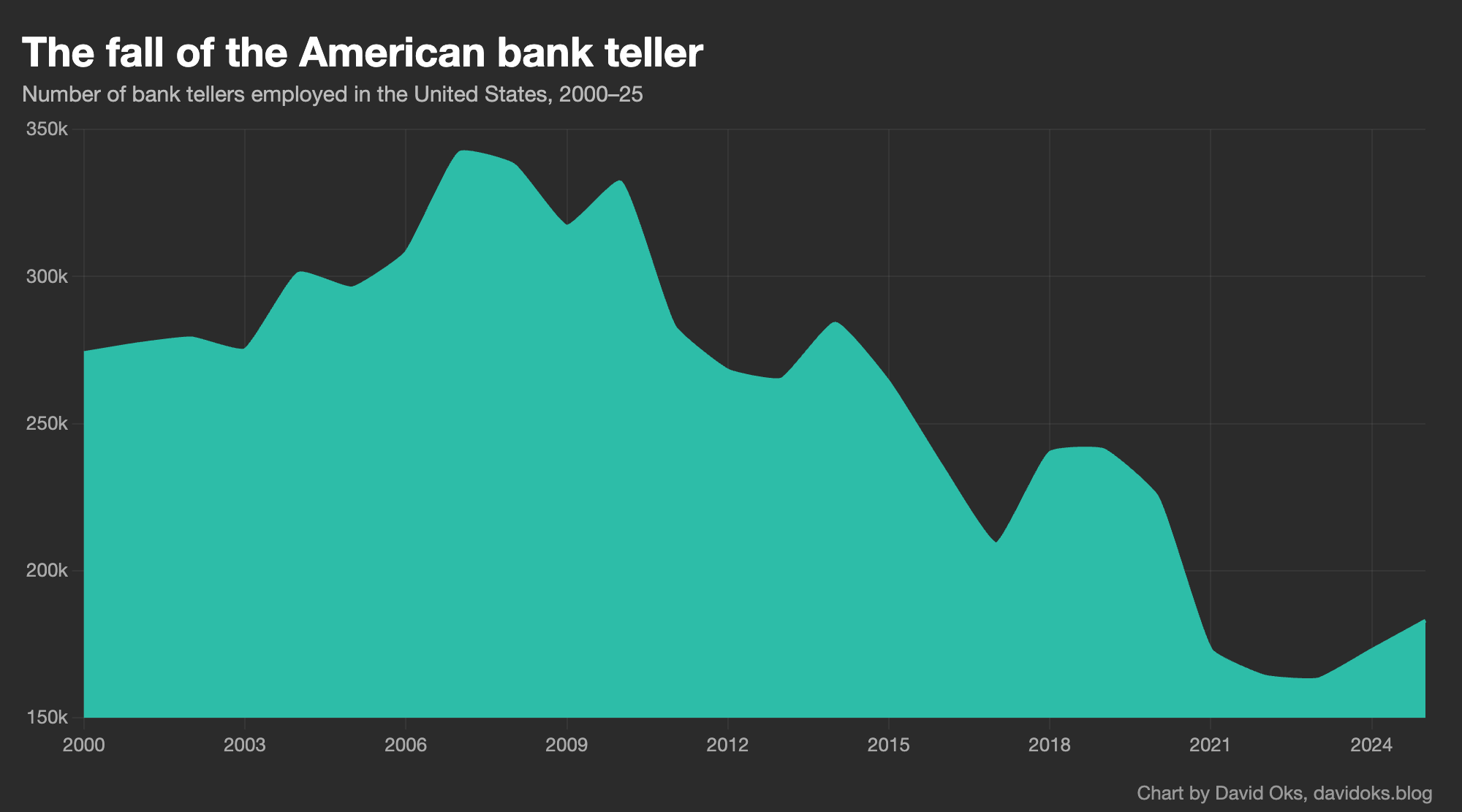
So, the story of productivity gains from technology isn’t one of reactionary Luddites standing in the way of progress. Some technologies complement people (ATMs, sorta) while some technologies substitute for people (mobile banking).
With AI, folks looking to soften the potential rough edges talk about it as pure complement while ignoring the substitution effects. Think the “AI won’t take your job, someone using AI will take your job” sub-genre of LinkedIn post.
A more galaxy-brained version of this sentiment invokes the Jevons paradox. William Stanley Jevons was an English economist who observed in the mid-1800s that as coal use got more efficient, people just used more coal—thereby increasing the total demand for coal. By that logic, if AI makes something more efficient, we’ll just use more of it. Aaron Levie, CEO of Box, offers a good example of this argument applied to knowledge work:
Jevons paradox is coming to knowledge work. By making it far cheaper to take on any type of task that we can possibly imagine, we’re ultimately going to be doing far more.
Like the ATM story, it’s not so simple. The Jevons paradox only holds in certain conditions. Namely, demand for a good needs to be elastic in the economic sense—the market can and will consume more of that good if the price goes down. This applies neatly to things like coal and AI tokens but doesn’t automatically apply to related jobs.
For the Jevons paradox to imply that there will be more jobs in a given AI-impacted role, it’s not enough to just have demand elasticity for the role’s outputs, AI must also be a complement—not a substitute—for the tasks that role does.
Let’s look at how those two criteria apply to RevOps.
AI: RevOps substitute or complement?
My last two posts offer some support for both positions.
On the substitution side, it’s clear that some of the most common RevOps jobs-to-be-done (JTBD) are very likely to be straight-up replaced by AI:
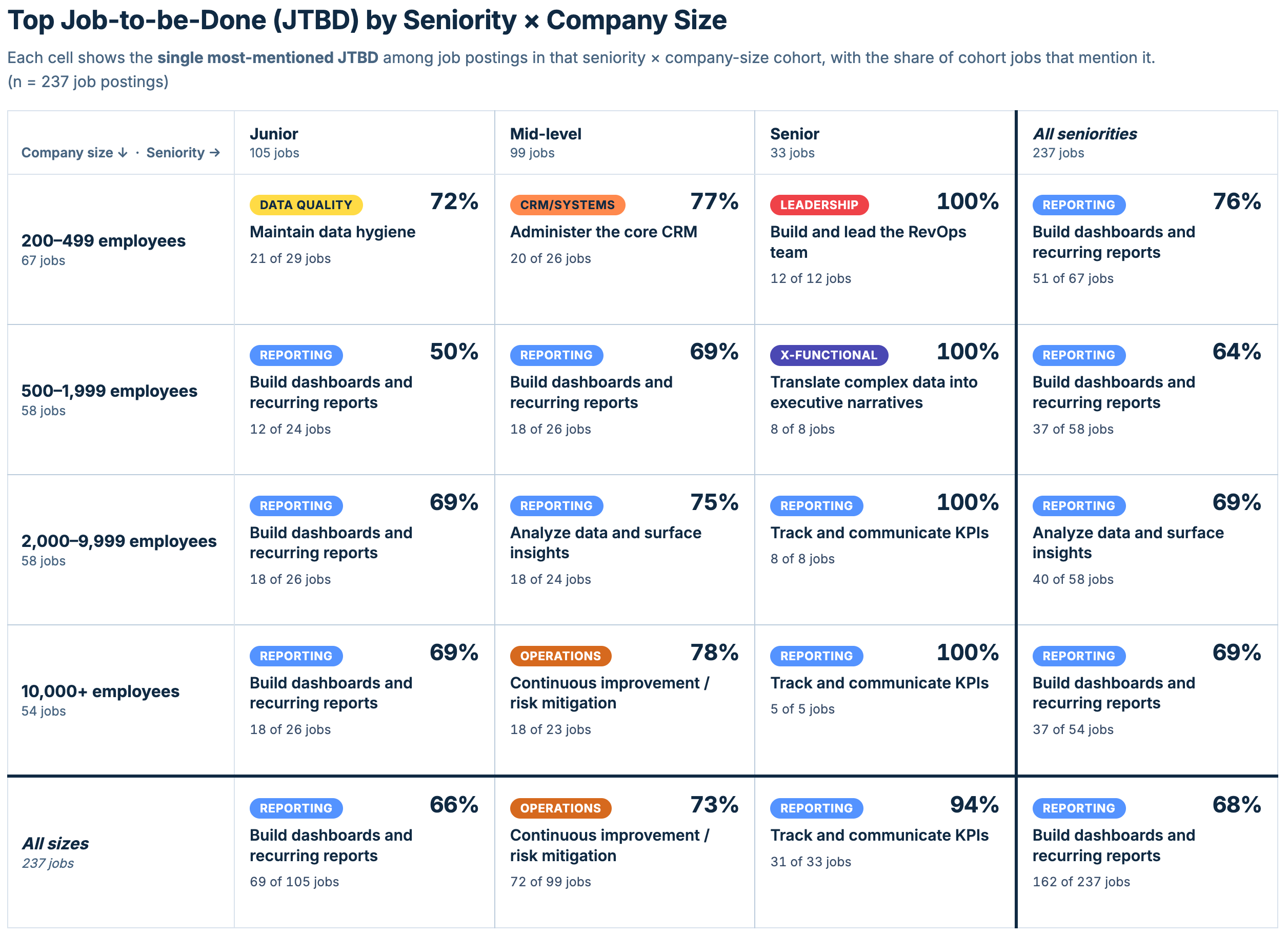
RevOps is first-and-foremost viewed as a reporting function. The kind of reporting varies by seniority, but ultimately it’s all about data in, data out. AI is extremely good at this kind of work. It stands to reason that there won’t be much reason to have humans do this in the future. Other prominent RevOps JTBD categories like data management, lead management and systems admin are also very AI-shaped.
On the complement side, RevOps—especially leaders—plays a critical organizational role: building a shared reality across stakeholders, setting strategy, and acting as referee. AI can help with those things, but can’t (yet) replace them.
It’s also likely that RevOps will own meaningful aspects of AI strategy, agent enablement and agent orchestration. So, the very existence of AI creates some complementary jobs-to-be-done. The emergence of the GTM Engineer as a RevOps-adjacent-but-distinct role is an example of this complementarity already surfacing.
The real question for the future of RevOps is whether the complements beat out the substitutes. The economists Daron Acemoglu and Pascual Restrepo give us a straightforward framework to think about the effects of a technology change on jobs. They break it down into 3 “effects”:
Displacement effect - automation performs tasks previously done by labor
Productivity effect - cost savings from automation reduce prices and expand output, raising demand
Reinstatement effect - the opposite of the displacement effect, i.e. new tasks get created where labor has an advantage
Putting it together, you can think of the impact on jobs from these effects as:
It sure seems to me that the displacement effect is likely to be larger than the reinstatement effect for the more junior roles in RevOps—those roles are just too filled with rote data analysis to see net positive demand. Senior roles, on the other hand, should see a smaller displacement effect. Those that embrace AI should see a stronger reinstatement effect.
That leaves the productivity effect. I have no doubt that AI will increase RevOps productivity. However, to fully consider the effect, we need to decide whether more RevOps productivity will be met with increasing demand.
Is RevOps too lumpy to be elastic?
Here’s a slightly different framing: if RevOps gets wildly more productive and each “unit” of RevOps output gets cheaper to produce, will companies want more RevOps?
Anecdotally, I’ve never met a sales organization that indicated their data was immaculate, their systems humming, and their reporting perfected. I’ve also never met anyone in RevOps who complained about having too little to do. All those are clear signs that if we could deliver “more RevOps outputs at a better price”, the market would want that.
What I have met are a lot of companies with understaffed or non-existent RevOps teams. This is especially true outside of B2B tech—those companies tend to have minimal ops support for their GTM teams. They’re not immune from the problems RevOps is built to solve, yet they’re not investing in it. That implies there’s some kind of barrier.
I think that barrier is that RevOps is a “lumpy” investment. RevOps is actually a collection of many sub-specialties bundled together. To get one month of territory planning or a good comp plan, you typically need to “buy” those capabilities in the form of a whole full-time employee. If you want systems administration or lead routing or data enrichment, you need to “buy” that in the form of another FTE or two. Oh and don’t forget that you’ll probably also need to equip those people with some specialized software.
So, while demand for the capabilities exists, fulfilling that demand often requires an investment that exceeds the actual need—kind of like buying a beach house to use twice a year. And just like vacation rentals exist to solve that challenge, fractional RevOps agencies exist to solve the RevOps challenge. However, agency unit economics still come down to people allocation and, as such, require retainers or commitments that minimize any true “on demand” capability.
In short, demand for RevOps outcomes is probably elastic if AI can unbundle them. That’s ultimately a strike against RevOps roles winning out in the Jevons paradox calculation. So long as the fundamental unit of RevOps input is a person—and that person only brings some RevOps JTBD to the table—you’ve got a bundling problem.
So what’s an operator to do?
Become a one-person RevOps org

Operators have two options to respond:
Figure out how to “unbundle” themselves so companies can buy only what they need
Make their “bundle” of capabilities so valuable that companies want the whole thing
Not surprisingly, both of the options involve mastering AI agents, because you’ve gotta fight fire with fire.3
Operators can ensure that AI complements them by building their own set of agents capable of doing a wide array of RevOps jobs-to-be-done. These agents should extend your capabilities and they should be your IP—not tied to any particular job. You build them up over time as you gain experience, and they become part of your value proposition in your next role.
That may sound a little odd until you realize that RevOps practitioners have always been hired for their experience, their skills and—often—their network. These agents are the logical extension of that for the AI era.
Armed with this agent army4, operators can then choose:
Unbundle yourself and pursue a fractional approach, providing specific capabilities to multiple companies with specific needs at a scale that was previously impossible for a single individual.
Bundle the total package together and offer your services as an FTE. The employer gets the capabilities of multiple specialists with a single hire and you command an outsized salary.
Combine the above with some people skills and baby, you’ve got a stew going.
I recognize this is a tall order. Not everyone can take this kind of approach to their role. Those who do, though, will have an AI-proof opportunity to benefit from their own personal slice of the Jevons paradox in action.
Shoutout to Why Are There Still So Many Jobs? The History and Future of Workplace Automation by David H. Autor for the pointer to the Time article.
Shoutout to Palen Schwab for a conversation a few weeks back that inspired this.