

I’ve been writing a lot about AI and agents lately. Some of that gets a little technical and wanders pretty far afield from “traditional” RevOps1 responsibilities.
For this week, though, I want to get back to GTM basics.
It’s September2. That means it’s annual planning time. And that means it’s time to focus on a meat-and-potatoes GTM topic that I love so much I named a newsletter after it: territory planning.
It’s a weird thing to love because, well, everyone hates it. Just ask them. It’s time-consuming. It’s frustrating. It’s high-stakes. Do it wrong, and not only will you miss the number, you’ll start losing disgruntled reps along the way.
But that’s why I love it. It’s a hard problem that forms the foundation for team performance. It’s also messy, combining quantitative data, qualitative opinions, and feelings in a way that few other processes—besides comp—do.
Nevertheless, running a high-quality territory planning process is a canonical RevOps responsibility. Like many things in RevOps, you don’t control every aspect of the process, but you’re accountable for ensuring it’s done well.
In this article, I’ll share my perspective on what good looks like for a RevOps leader tasked with owning this process, based on what’s tripped me up in the past. I break the process into 5 distinct phases:
Align on the big strategic questions
Wrangle the data and analysis
Build the initial territory design
Gather feedback and iterate
Go live and support
Note that this isn’t a strict waterfall. In particular, Phases 1 and 2 tend to have some tricky dependencies. You can’t define strategy without data, but you also can’t know exactly what data to look at until you understand the big business priorities.
With that in mind, let’s break down each phase.
Align on the big strategic questions
Here’s a non-controversial take: your territory design should be a byproduct of a well-considered GTM strategy plus the financial model that supports it.
It’s never that simple. Strategy is hard because it means making real choices with real opportunity costs—often using ambiguous data. Say you decide to focus on the enterprise. That means giving up on smaller deals that might move faster. Where exactly do you draw the line on “too small”?
As a GTM organization, you have to actually make these hard choices. A poorly defined strategy leads to poorly defined priorities. Poorly defined priorities lead to poorly designed territories.
Think about it: you want white-glove service for your existing customers because you believe service is a competitive advantage AND your board wants attachment revenue from your latest AI product. You balance your territories on equivalent expansion potential but also try to cap them on total customer count to provide good service. Which takes precedence when those goals conflict? That’s a strategic decision that RevOps can’t “just figure out”.
These kinds of conversations are part of a healthy annual planning process, of which territory is just one part. If you’re responsible for leading territory design, you need to make sure that your entire set of stakeholders is aligned on the overall strategy before you start. Otherwise you’ll just end up adrift in a sea of what-ifs.3
The first step is to get the highest-level stakeholders together—CEO, CFO, CRO—and ensure broad alignment on the overall strategy.
One mistake I see from RevOps folks is trying to get too specific at this stage. The right questions don’t sound like “What’s the employee count breakpoint we should use for segmenting Mid-Market and Enterprise?” Instead, they’re about learning the big strategic priorities and growth levers. These are things like moving up-market to increase ACV and improve gross margins; increasing share of wallet via cross-selling some new product line; focusing more on PLG to combat an upstart competitor; driving international expansion; or lowering costs to positively impact EBITDA.
You don’t have to have all the answers at this point—you just need to understand the big challenges. The next phase is where we start to get into the details.
Wrangle the data and analysis
Armed with the big strategic goals, you need to start filling in the blanks that pressure-test the strategy and clarify what needs to be true for it to be realized. This is where data comes in.
You’ll need both historical sales performance data and account data. Make sure your team has the time and budget required to ensure both are in good enough shape. I say “good enough” because your data will never be perfect. You could spend infinite time and money trying to achieve the impossible. Make sure you timebox this step or it’ll never end.
Since we’re focused on translating strategy to territory design here, I’ll take a moment to focus on account data. Unlike historical sales performance data, account data often comes from external providers. This includes the firmographic and technographic data that you’ll rely on later to build good account scoring, and segmentation (more on that in a moment).
There’s very little excuse for outright bad firmographics and technographics these days. OG providers like ZoomInfo are desperate for your business, Clay will happily burn your credits on waterfall enrichments, or you can vibe-code your own enrichment workflows. None of this is free, but it’s genuinely never been easier to get high-quality enrichment data.
As you’re enriching your account data, pay special attention to hierarchy data in particular. Many territory designs hinge on hierarchies, requiring territories to be built around account families and not individual accounts. One sure way to frustrate your reps is to assign HQ to one person and some set of subsidiaries to another.
Once you’ve pulled all this together, the next step is to take the raw data points and turn them into something usable. This is where whitespace analysis, account scoring and segmentation come in. I won’t go in depth on this type of analysis in this article. Instead, I beg you, go watch this video where Grant Hefler, Executive Consultant at SBI, shares their approach to scoring and segmentation. Seriously, companies pay very large sums of money for this advice and he just lays it all out.
As I said in the opening, this isn’t a waterfall process. There will be some loops. Now that you’ve got high-quality data informing high-quality analysis, you can go back to leadership and work out the specifics that align things like revenue potential and segments to the big strategies. You may even end up calling some of those big strategies into question if the data don’t support them.
Once you’ve iterated on the strategy with data, it’s time to actually build the first version of your territory design.
Build the initial territory design
For most sales teams, territory design means one thing: carve up the world into geographic chunks once a year, hand a chunk to each rep, and say “go get ‘em, tiger”.
This traditional approach leaves much to be desired, especially for higher-velocity inside sales (like most B2B SaaS). In those cases, one-time geographic carves don’t make sense. Dynamic books is the answer. Just skip the high-stakes carve and continuously allocate accounts year-round.
But that’s certainly not every sales process. Sometimes relationships, industry specialization or—yes—geography really are dominant factors.
The important thing is that you choose a basic design approach that best maps to your strategy. You may even want to choose different overall designs for different segments.
I break territory designs into 5 main archetypes, grouped into a “family tree”, like so:
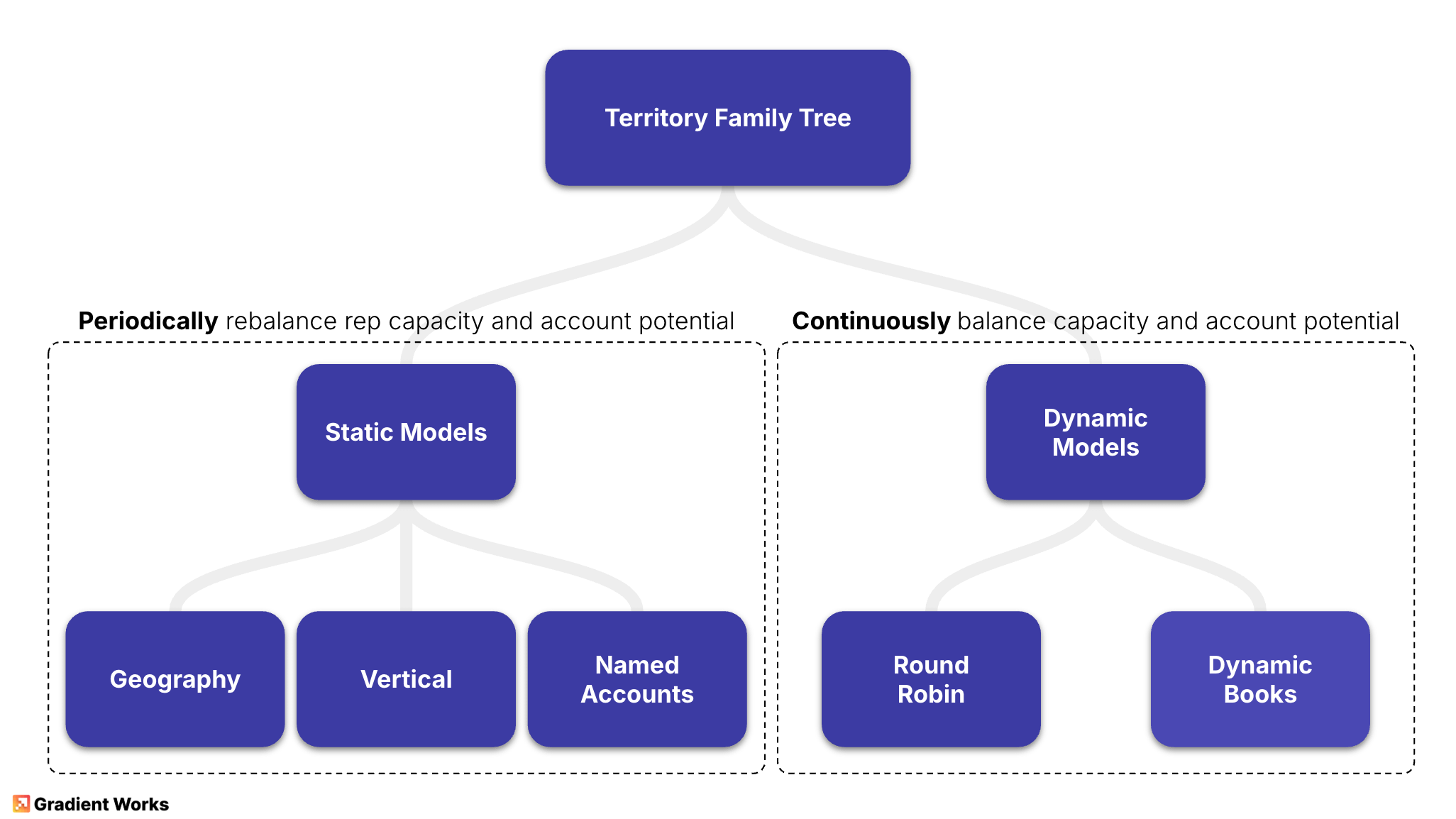
Let’s break down when you’d choose which:
Geographic - You have field sales, extensive market data and highly predictable sales patterns OR there’s a material variation in sales process across geos.
Vertical - Your GTM requires high specialization for different verticals and you have enough market data to be confident about demand in those specific verticals.
Named - You have a long sales cycle that requires building relationships and value over time along with high confidence in specific accounts that you want to target.
Round Robin - Your GTM is mostly inbound-driven, sales cycles are relatively short, you have a small sales team and those reps have mostly the same length of tenure.
Dynamic Books - You have relatively fast sales cycles, have a hybrid inbound/outbound model, and are dealing with demand and headcount uncertainty OR you’re trying to maximize coverage of a known TAM.
The choice of archetype tells you one kind of constraint on your territory design, but it’s only part of the story.
The next set of constraints will be based on your core balancing criteria. Those usually come from your segmentation and scoring. The most common balancing criteria are revenue potential combined with some sort of aggregate cap on the number of accounts.
Finally, there are all the other considerations that go into a good territory design. Some common ones:
Holdovers - Which accounts must stay with their current reps due to existing sales cycles or relationships?
Hierarchies - Are you assigning HQs to territories or can subsidiaries be assigned independently? For geographies, what location “counts” for determining the geographic location of the account?
Language or culture - Do you need to keep some accounts together regardless of your overall strategy? This is most common outside the US, which is blessed with a large homogenous market.
Channels / partners - Do certain parts of your GTM motion involve optimizing for channels that would otherwise cross normal territory boundaries?
Hard vs. soft geographic constraints - Do you absolutely need to build territories around field rep locations due to required physical visits or due to regulations that differ by geography? Or is geography more about minimizing relatively infrequent travel or timezone differences?
This becomes very complicated, very quickly. If you’re doing this manually in a spreadsheet, you’ll probably need to limit the number of factors under consideration and develop a strict rules hierarchy. You can do it, but it’s tough.
This is where AI comes in very handy. Whether it’s a purpose-built tool like Gradient Works’ Carve4 or a bespoke application built with a coding agent, you can usually get better results than trying to hand-build Excel formulas.
Ultimately, you want to produce a first draft of the territory design that comes as close as possible to meeting the balancing criteria you’ve developed. In the end, this probably looks a lot like a spreadsheet of some kind with a row for each account and columns for the current assignment and the proposed new one.
Now comes the really hard part.
Gather feedback and iterate
So you’ve put a plan together. Now you need to make all the stakeholders—from the C-suite to the front-line managers—happy. It’s worth remembering this famous quote:
“No plan survives contact with the enemy.”
- Prussian Field Marshal Helmuth von Moltke (sort of)
Now, these folks aren’t your enemies, but they for sure will alter your carefully built plan. And it’s this stage that can turn an efficient territory process into a very long slog with endless rounds of “feedback” and reassignments, each time requiring you to rebuild large parts of the plan.
The best thing you can do here is manage the process carefully:
Communicate why and how - Explain the strategic reasoning behind the plan and the data that drive it. This is where a narrative and a set of charts showing how you’ve balanced key criteria can do a lot more than just a list of assignments.
Define clear policies upfront, especially about disputes - Put reasonable limits on the number of overrides or reassignments that each individual stakeholder can request. If possible, require a rationale for any changes. Finally, make sure that it’s clear who has the final say if there’s a disagreement.
Standardize the feedback process - Having every manager provide feedback in different ways—Google Sheet comments, random notes in Column AH in Excel, Slack messages, emails, etc.—will drive you crazy. It may feel pedantic, but pick a method for collecting feedback and stick to it.
Maintain version control - You don’t want to end up with a folder full of files like Territory27_Final_v2_FINAL_FINAL.xlsx or, worse, a scenario that you overwrite and can’t recover. Establish a sane file-naming convention, use named versions in Google Sheets and/or make very liberal use of Save As. I also suggest you keep a change log of notes that make it clear what each file contains, similar to how a developer uses their git commit history.
These last two pieces are where spreadsheets really tend to fall apart. If those are starting to bite, you’ll probably want to consider investing in a tool.5
Once you’ve incorporated feedback and iterated, you’ll end up with a plan that’s ready for go live.
Go live and support
I won’t go into the technical details of go live because they’ll vary based on your CRM, team size and GTM approach. I know some teams that can do a simple data load in 10 minutes and some teams that need to carefully choreograph a sequence of field updates, automation toggles, and related object upserts over the course of several days.
The most important thing about go live is that you communicate to stakeholders—especially the reps themselves—what to expect during the transition. Once the reassignments take place, you and your team need to be ready to handle rep questions quickly and respectfully. Plan to provide elevated support and TLC for at least a couple of weeks after the transition.
Wrapping up
Running a high-quality territory planning process is hard no matter what. I’ve seen this process spiral out of control too many times with the end result being a kind of collective exhaustion that just ends with a small tweak to the status quo.
That’s a waste of organizational energy, and it doesn’t have to be that way.
Start by understanding the overall strategy and the supporting data. Everything builds on that. From there, a thoughtful initial design, a controlled feedback loop, and a careful go-live process will help you deliver a plan that puts your team in the best position to execute in 2027.
With good reason. RevOps is increasingly an AI-first role.
Even though it’s still over 100° most days in Austin. Sigh.
This is how I once ended up in a 9-month territory fight.
This is a shameless plug because I feel no shame doing it. We’re very proud of Carve.