


A few weeks back I wrote a post about what to do when you take over a sales team. I talked a lot about quantitative analysis but only a little about the qualitative side of things, especially talking to customers. That’s an incredibly important topic that really needed its own post. Well, dear reader, this is that post.
I want to share what’s been working for me to learn from our customers. Hopefully it’ll help you too—whether you’re starting a new role or just hoping to refine your team’s messaging and positioning.
First, a little history. In a past life, I co-founded a social media analytics company called Union Metrics. I was a first-time founder and I made a stupid (but classic!) first-time founder mistake1: I didn’t talk to our customers enough.
We had several thousand customers, many of whom were SMBs. I believed we were more sophisticated than they were about social analytics and—instead of listening to them—it was our job to show them what they needed. It was an immature, egotistical Henry Ford “faster horse”2 perspective that held us back.
Gradient Works is very different. We have fewer, larger customers and I know how much their feedback matters. I talk to many of our customers frequently, but I’ve never felt like I’ve built a system for gathering customer feedback that both improves our GTM and makes our product better.
As we’ve started to expand our platform (and packaging) with Carve, I’ve begun to focus on that more. I’ve learned a few things that have helped me make sure customer interviews a) happen consistently and b) end up providing useful feedback.
I’m indebted to Paul Stansik who introduced me to Forget the Funnel3 by Gia Laudi and Claire Suellentrop. I’ve borrowed liberally both from Paul’s writing in this area as well as the book itself. I highly recommend you read both.
That said, I do feel like there’s a gap in the discourse. Most of the content out there about customer interviews is written from either a marketing or product perspective. I’ve tried to approach this from a sales leader perspective. I’ve also tried to keep it tactical because talking to your customers doesn’t work if you don’t actually, you know, get the meetings to get their input.
Getting the meeting
Interviewing customers ought to be easy. Booking a customer meeting is certainly easier than booking a call from cold outbound. It’s not, however, easy.
You know what is easy, though? Talking about talking to customers without ever actually talking to customers. In fact, most GTM orgs excel at it for several reasons.
Your customers are busy with their actual work and have multiple vendors vying for their attention. They’ve been burned by meetings with friendly CS reps who want to “align priorities so we can better serve your needs” that devolve into a pitch for some new AI add-on. Even if they really like you, they may not be jumping at the chance to chat with you—emails go unanswered, scheduled meetings gets pushed at the last minute. Before you know it, it’s taken 6 weeks to have a simple conversation.
Another thing that gets in the way is making “customer research” into a big production. You might find yourself stuck in some political morass about who “owns the initiative” and “owns the customer relationship”, etc. A process that started with “let’s learn some things from our customers” suddenly becomes a 25-slide PMM powerpoint with schedules, milestones and RACI matrices.
If that’s your lot in life, I’m sorry. This process will be a little harder. However, remember you can just do things. And if you’re a senior GTM leader, talking to customers is not only something you can do, it’s something you must do.
Luckily I’m not currently at a big company so I don’t have worry to about the politics of it all, but I think the approach I outline below can help regardless of your situation.
Just like with setting an outbound meeting, setting a customer interview works better if you strike while the iron’s hot. In outbound, that might mean some kind of in-market signal. With your customers, you probably already have the signal you need, you’re just not looking at it.
Here’s what I do. Every morning I check our product analytics to see who’s been doing what.4 I pick 1-3 overall heavy users who have some recent activity from the last couple days and I send them an email.
It goes something like this:
Hi [person],
I’m CEO of Gradient Works. Saw you were using [X feature] recently. We’re trying to understand more about how folks are using [X] so we can improve it.
Would you have 15 minutes to provide some quick feedback? If so, feel free to grab some time at the link below or I can send over a few suggestions if you prefer.
[calendar link]
Let me know!
Hayes
Three things to note here:
I’m trying to make a thing they’re actively using better, not upsell them. Hopefully this defuses any “Oh god what AI thing are they selling now?” defenses.
I’m only asking for 15 minutes, so it’s low-commitment.
I’ve given them a calendar link to book something immediately without back-and-forth while also offering to handle scheduling if they want (some people still get a bit squirrely about the etiquette around calendar links).
The conversion rate on this email is very good—I almost always get the meeting. I’m sure it helps that I’m the CEO, but I’d wager that any other reasonably senior leader could get similar results.
There’s one drawback to this approach, especially for enterprise software: your day-to-day product users may not be your buyer. In that case, the research you do with these users is necessary, but not sufficient, for informing GTM.
That said, the gap between buyer and user keeps shrinking. People like Jason Lemkin are telling senior leaders to deploy agents themselves and Kyle Norton is making it clear that RevOps leaders need to become technical. If your product matters, chances are some of your hands-on-keyboard users will also be buyers. You can always cross reference your product user data with LinkedIn to verify.
So, you’ve got 15 minutes on the calendar. What do you do during the call?
Running the meeting
Treat this meeting like a discovery call.
Unless you’ve just arrived from 2010 (in which case… my god are you in for some surprises), you wouldn’t run a discovery call without using something that captures video and transcripts. You’ll want that information for later. I personally use Zoom + Fathom.
Also like a discovery call, the interview will be incredibly valuable if you ask good questions and a huge waste of everyone’s time if you don’t.
This is where Forget the Funnel comes in. If you haven’t read it, it’s a quick ~150 pages. In Chapter 3, they give you a set of open-ended questions that really work to help you understand your customer’s situation. I blend their questions with a couple of my own:
How are you using [product]? What’s your goal?
How were you doing [thing] before [product]?
Why did you start looking for a different way to do [thing]?
Why did you choose us over other options?
What’s the number one thing you’re able to do now with [product] that you weren’t able to do before?
What do you wish [product] did that it doesn’t do today?
How would you describe the value you get from [product] to a peer?
Question 2-5 are nearly verbatim from Forget the Funnel, while 1 and 7 are my own additions. I feel like asking them in this order provides a solid (albeit tight) agenda and flow to the call. That said, they’re not all created equal. If I find myself pressed for time, I make sure to ask 2, 5 and 7.
Here’s why I think those three are so important:
How were you doing [thing] before [product]?
The answer helps you understand the struggle5 your customer was going through to solve their problem before they found you. You can turn these answers into mind-reading—articulated pains that resonate with your prospects.What’s the number one thing you’re able to do now with [product] that you weren’t able to do before?
The answer will help you figure out your most important value proposition. This is the thing that your users actually care about among all the things your product does. This may be very different than you think. Your “comprehensive AI platform for X” is probably—to most users—defined by one key capability.
How would you describe the value you get from [product] to a peer?
There’s money in this answer. Not only can this give you a great soundbite, but it helps write your marketing copy for you. It can also highlight issues. If the answer isn’t short, sweet and similar across customers you need to dial in your value prop.
Once you’ve asked your questions, be sure to wrap up the meeting by confirming any next steps. Pay special attention to any complaints or product gaps and make sure you get that to the right CS or product folks for follow up. If the customer is happy, now’s a great time to ask for a referral and/or permission to use something they’ve shared publicly.
You’ve asked your questions and you’ve got a recording along with AI transcript. What now?
Learning and operationalizing
Once you’ve captured a few of these transcripts, you should pull out useful themes with the AI process Paul Stansik describes here:

Paul’s process is really all you need to start getting value from these transcripts.
You can go deeper, though, and align customer feedback around the “jobs to be done” (JTBD) framework as described in Forget the Funnel Chapter 5.
I won’t go into everything about JTBD, but the idea is that customers “hire” a product to help them do a job. A customer’s job to be done can be summed up in a statement like:
When I (struggle), help me (motivation), so I can (desired outcome).
The goal is to extract common themes from your interviews that align to struggle, motivation and desired outcome for different customer job statements. You can do this manually or with AI. The output might look like the table below from Forget the Funnel.
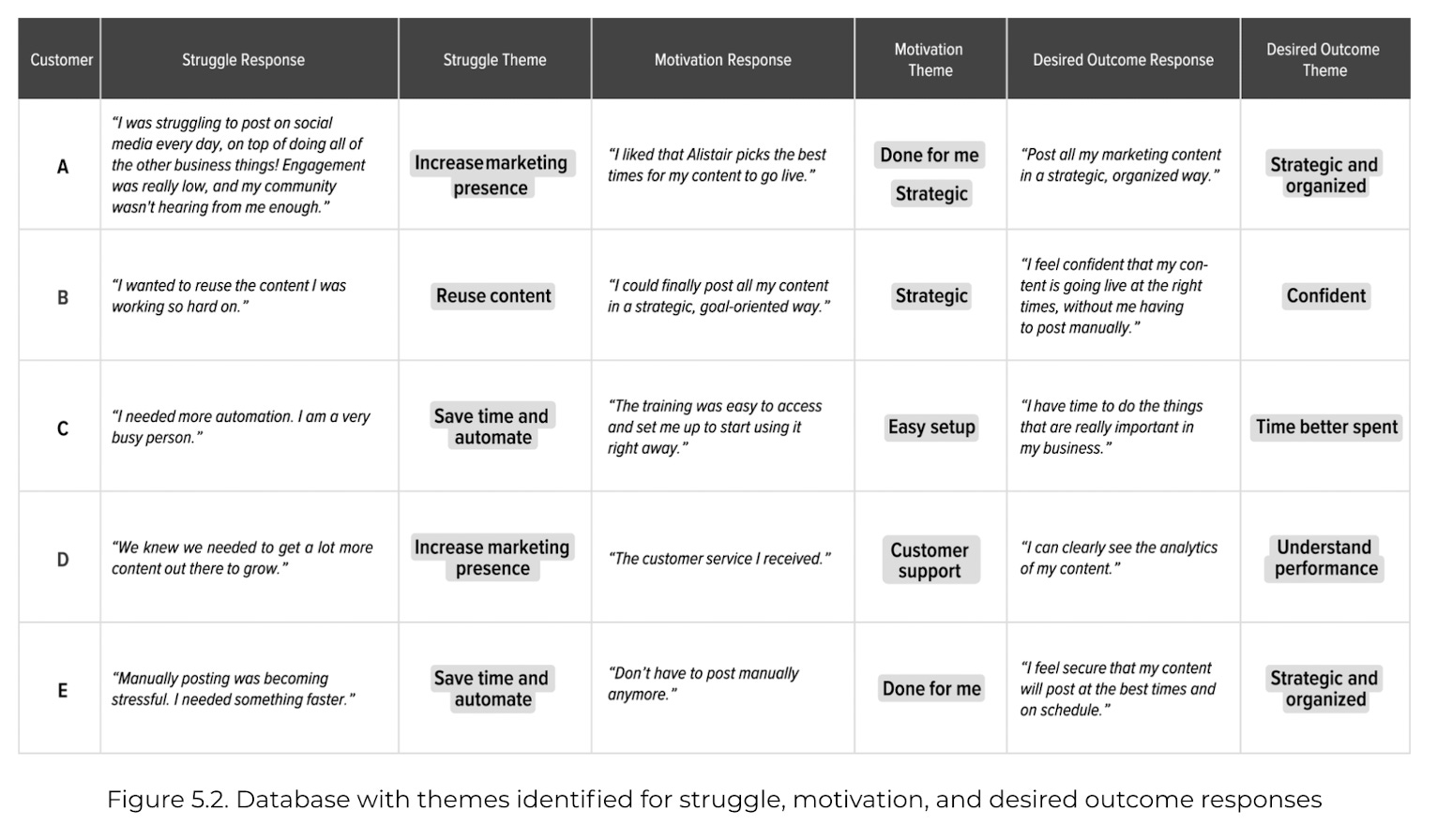
Stack rank these jobs based on the ones that appear most frequently and are most correlated with urgency and willingness to pay. Pick the top one and use that as input for enablement materials, outbound messaging and talk tracks.
Finally—and you’ll want to partner with marketing on this one—make some clips from the videos. If you have customer permission, share them publicly even if they’re not polished. Authenticity beats high production values in 2026.
If you can’t share clips publicly, share them internally with reps so they can learn to speak in language that sounds like their prospects.
Wrapping up
Remember, if you’re a GTM leader, it’s your job to talk to customers. Don’t let institutional inertia get in the way.
Make it easier on yourself by setting quick calls with recently active customers. Ask consistent, open-ended interview questions and record it all. Synthesize multiple calls with AI and share real clips as much as possible.
Rinse and repeat for the secret to growth.
One of many.
Ford probably never said the phrase: “If I had asked people what they wanted, they would have said faster horses.”
Not to be confused with the somewhat-related Flip the Funnel. The tl;dr here is that people really don’t like the funnel.
The Forget the Funnel folks really like that word.
What a novel idea, imagine talking to your customers about how they use your products and how we might improve the customer experience........
Sorry for the sarcasm Hayes. What you are talking about is so important, but too few organizations even care. There is so much everyone, at all levels, can learn from customers--not about what we sell, rather how they are actually using our products.
In the spirit of Yes and..... Something that I have seen companies do with extremely high impact is that in addition to talking to them about how they use the products, watch them as they use the products. You see so many things that are not likely to come up in a conversation. Even simple keystrokes, or the way the interact can provide insight.
One of my suppliers did this with me recently. He asked me to record about 30 minutes of my interaction with his tool. It's something I'm using constantly, so I just recorded what I was doing and sent him the video. A few days later, he called me saying, "Dave, I've loved to talk to you about this." He had observed things that I was doing, saw some mistakes I was making, and saw some things he could do to improve the product tremendously. It's a powerful complement to the interviews.
Could not agree more