

Earlier this year Kristina McMillan and Scale Venture Partners surveyed 300 GTM leaders to learn how they’re using AI. They recently published their report: The State of GTM AI in 2025. Kristina, Scale EIR for GTM AI and long-time analyst in the space, was kind enough to join me for a conversation about their findings.
This time last year, I wrote that you’re not behind in AI (which also used some Scale data). What a difference a year makes. Scale’s 2025 report makes it clear that the gains from AI adoption are real and they’re happening now. If you’re not taking advantage, you really are falling behind. The good news is the current wins are mostly based on individual productivity. There are much bigger gains ahead and you can still (probably) catch up.
Go grab the report for yourself and follow along with the conversation!
For those of you who prefer words, below are some of the key topics and takeaways from the conversation.
Everyone’s actually doing it, and it’s working
“The short answer is everybody’s using it. The other part of that answer is it is working. […] And if you’re not leveraging it today, you are falling behind.”
Kristina started our conversation by laying out the takeaways from the Scale report.
We’re about 3 years into the AI era (ChatGPT was released in late 2022) and we’re now reaching the end of Phase 1 of GTM AI adoption. This phase has largely been about increasing individual productivity with relatively simple use cases like drafting content and doing account research.
The team at Scale found that regular use of AI is ubiquitous in GTM (even if it’s a bit “lumpy” across teams). If your reps aren’t using AI to impact their individual performance today, you are most definitely behind.
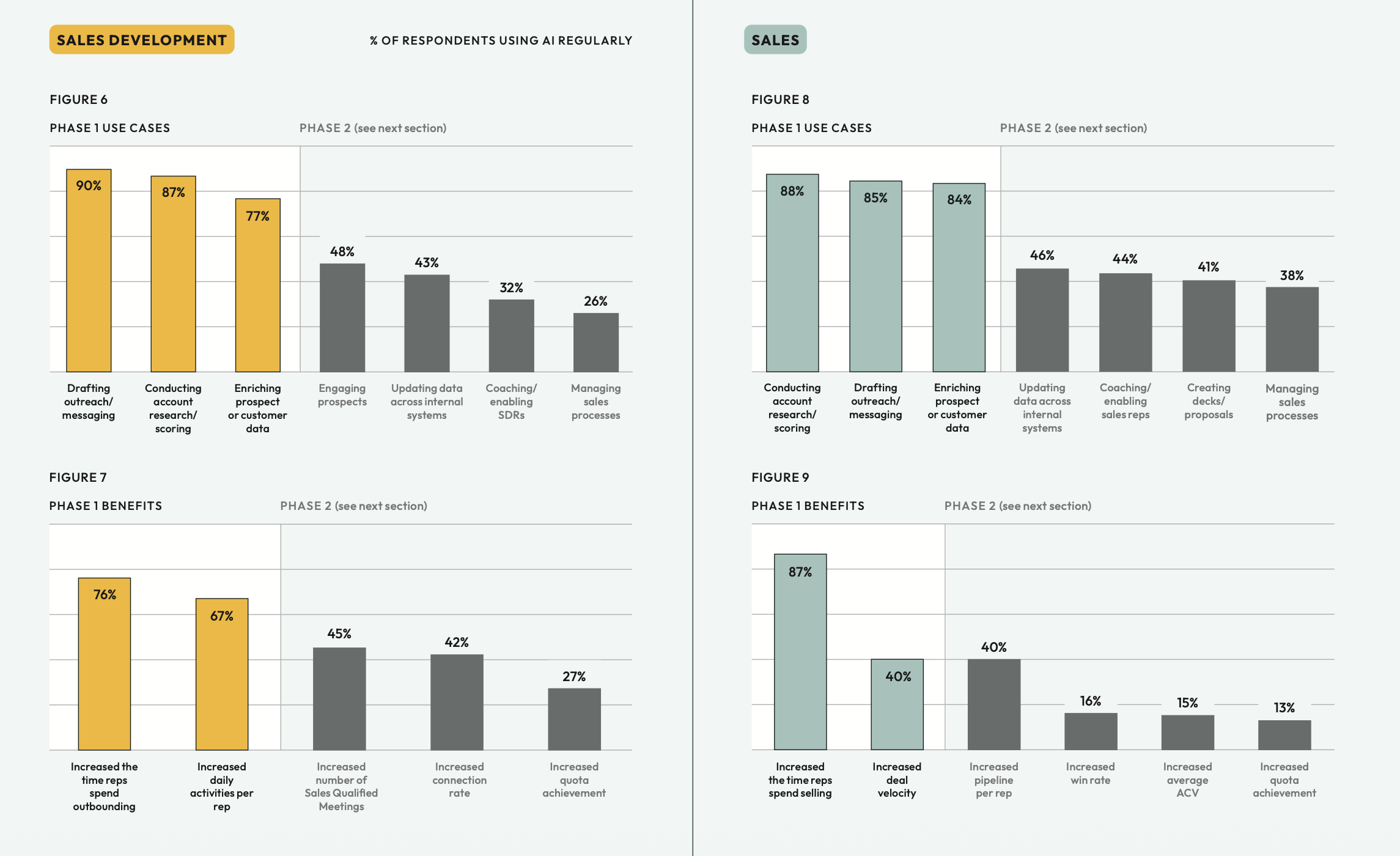
The most important takeaway here is that all this adoption really is having an impact, especially when it comes to quantity metrics (e.g. activity levels) and time savings. Kristina shared an example where Vanta has reduced the time reps spend on non-sales activities by 10 hours per rep per week.
The next phase will focus on quality1. Kristina predicts that emerging AI use cases like rep coaching will have a much more direct impact on metrics beyond simple productivity gains—she expects to see material gains in areas like sales cycle length and rep attainment.
You need to build and buy
“We got used to buying [SaaS] and administering it and setting it up and getting everybody up on it. It made sense for us. Right now we’re in a period where things don’t make sense. […] Maybe the extra lift of building it is okay because buying is kind of complicated.”
I wrote about build vs buy not too long ago and Kristina had a lot to add to that discussion. AI has certainly scrambled the traditional “build vs buy” calculus.
Kristina shared a simple framework for thinking about the decision based on task complexity. You can see the visual from the Scale report here:
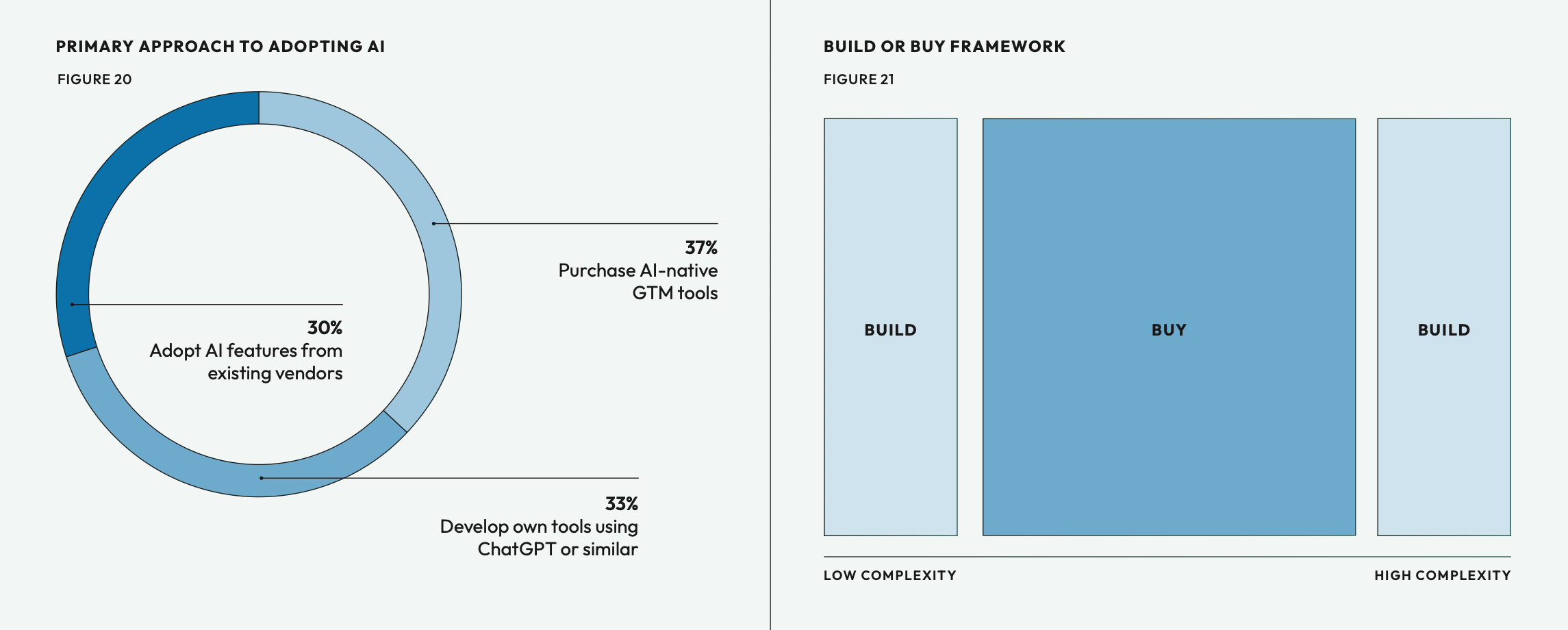
If your task is very low complexity (e.g. individualized account research) and can be accomplished directly in AI tools like Gemini or ChatGPT, don’t bother buying anything specialized. By the same token, if your task is very complex and highly specific, you’ll probably need to build your own.
For middle-of-the-road use cases, you should probably buy. As Kristina notes, you’ll benefit from the best practices that vendors are able to codify by working with lots of customers at once.
A word of caution, though: buying AI tools is hard. There are tons of point products and it’s unclear how durable they’ll be. Pricing is evolving and it’s hard to model costs. That said, the same challenges around long-term durability and costs can be applied to internal builds as well.
Kristina summed it up pretty nicely: “Right now we’re in a period where things don’t make sense.” Start small and see how far you can get with basic LLM tools. Scale has a nifty “game board” to help you on this journey.
Keys to adoption and measurement
“We saw that when RevOps was involved in AI initiatives, that it had a 20% higher impact.”
As a former RevOps leader, I was gratified to hear Kristina share that RevOps involvement improved AI initiative impact by 20%. However, that impact can only be felt if you have a baseline to measure against.
Kristina said the need to establish the baseline emerged in the qualitative part of their data collection. She saw teams doing time studies to figure out bottlenecks as well as running some controlled experiments to see incremental improvements before going all-in.
Speaking of all-in, she highlighted the initial AI SDR craze as cautionary tale about AI adoption. Some folks fired their whole SDR teams only to discover the tech wasn’t ready. Those orgs ended up with pipeline gaps and had to scramble to rebuild their teams.
Ultimately, Kristina sees AI adoption as a process of stacking gains on top of gains. Each individual gain might not be obvious, but the aggregate effect can be large. Scale is recommending two metrics to measure this holistic impact: GTM Efficiency and GTM Productivity. You can see those defined below:
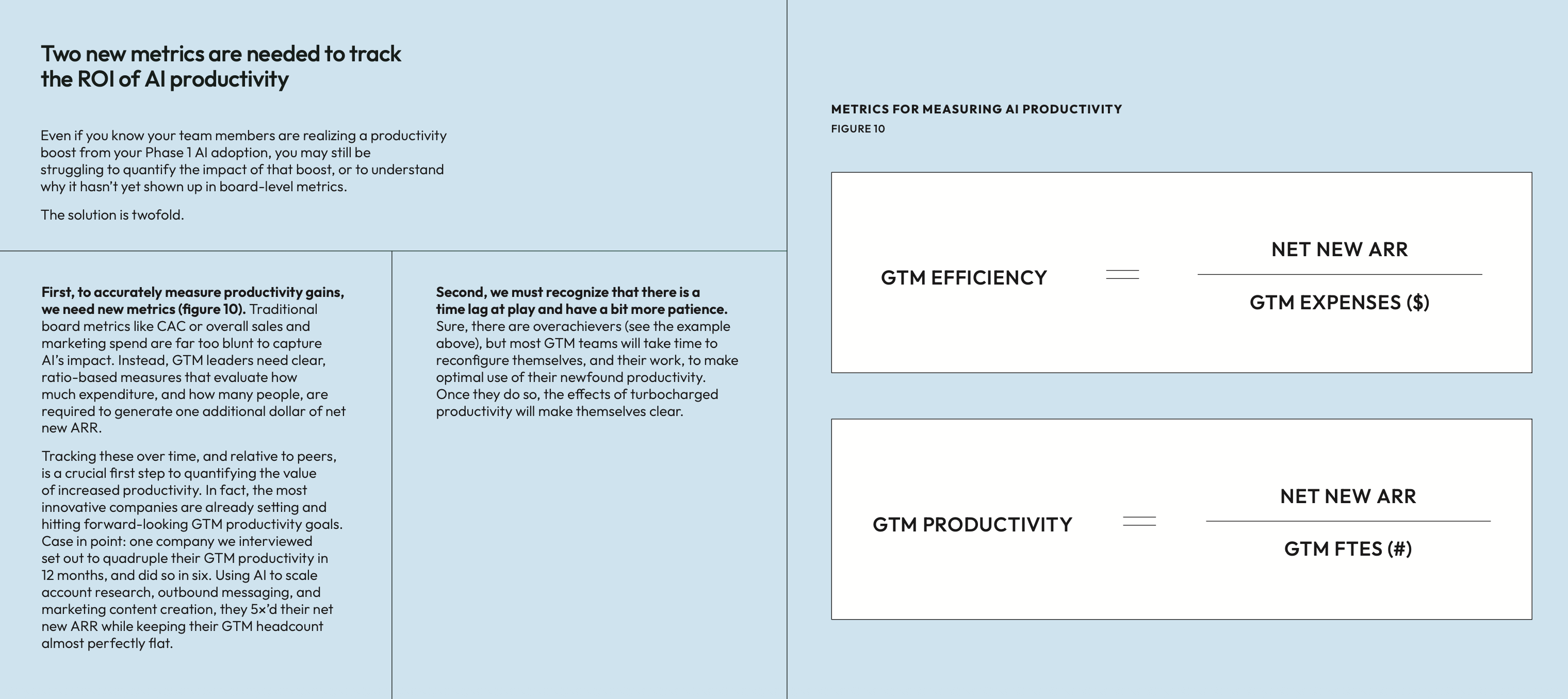
These bear some similarity to the SaaS magic number and ARR / FTE, respectively, but centered more tightly on new revenue growth and GTM. Regardless, these org-level metrics should show material improvement over time if the combination of your AI efforts are driving efficiency.
How org design needs to change
“There’s a lot of temptation to completely redesign your org. But the reality is, from where we sit today, you need to think about what that next step or two looks like. So you really can’t reimagine what your org is gonna look like in 10 years, because we have no idea.”
Nobody actually knows how GTM orgs will evolve due to AI, but Kristina did have a few takeaways about the current state of evolution.
AI adoption can’t be something people do in their spare time. There’s just too much technical know-how required and too much change to keep up with. Someone (or someones) has to be focused on it. She’s seen orgs have success forming “tiger teams” devoted to AI adoption.
While you do need someone driving AI adoption, you should also be harnessing energy and excitement from more junior employees who may be more AI native. Kristina cited front-line managers building out AI enablement tools for reps and technically-inclined early career folks stepping up as GTM Engineers.
Speaking of GTM Engineers, they are “definitely a thing”. The role isn’t terribly widespread yet, but Kristina believes it’s going to grow in importance.
We actually ended the conversation talking about AI agents. Kristina sees most folks in GTM use the term “agent” as largely a shorthand for any AI capability that’s more complex than just a simple chat.2
Most of today’s “agents” don’t rise to the level of replacing an employee on the org chart. Kristina’s advice is not to over-engineer agents to try to do too much just yet—a partially automated task requiring tons of human intervention is probably worse than one without the automation. That said, agents will continue to get more sophisticated over time and someone will need to “manage” them by being familiar with their capabilities and knowing how to deploy them effectively.
We may not know what our orgs will look in 2035, but there’s a good chance they’ll change a lot more in the next 10 years than they did in the last 10.
This fits with my general thesis from The 10x Sales Rep. Increased activity levels won’t get the job done.
I’m a little more of a purist and think “agent” should be reserved for AI systems with some level of autonomous decision-making.


