


I’m feeling a little rusty today as I come off a two week hiatus. Since I send these on Thursday morning and the last two Thursdays were Christmas and New Years Day, respectively, I figured I wouldn’t interrupt your (or my) holiday cheer with a newsletter.
I’m back now and ready for 2026. I think this is gonna be a bumpy year for B2B sales, so we might as well focus on things we can control. What better way to do that than to make resolutions? Those always work!
Jokes aside, I genuinely do think these are critical. Do these things well and much of 2026 falls into place. Here’s hoping they stick better than that gym membership.
Let’s dig in.
Resolution 1: Start every quarter with enough pipeline
I’m a big fan of Dave Kellogg. One of my favorite things from Dave is his simplification of sales down to two questions:
Are we giving ourselves the chance to hit the number?
Are we hitting the number?
Question 1 is most important. If the answer’s “no” to #1, the answer to #2 is—barring a miracle1—definitely no. The metric, of course, that lets you know if you have a chance is pipeline coverage.
Here’s a quick refresher on pipeline coverage: it’s the pipeline you have when you start a period (quarter, month, etc) divided by your target for that period, expressed as a multiple (e.g. 3x).
Let’s say at the start of Q1, your total pipeline with a Q1 close date is $3,250,000 and your target is $1,000,000. There you go, 3.25x pipeline coverage:
It’s also important to note that pipeline coverage isn’t simply the inverse of win rate (e.g. 20% win rate = 5x coverage) because your starting pipeline consists of a blend of opportunity stages—which have different win rates.
So far so good. But our resolution is about “enough” pipeline. So what constitutes “enough”?
The received wisdom is to aim for 3x pipeline coverage, but your mileage will vary. The best way to answer this question for your team is with historical pipeline snapshot data. If you don’t have that, you can use the equation on the right side of this slide from Jeremey Donovan at Insight Partners:
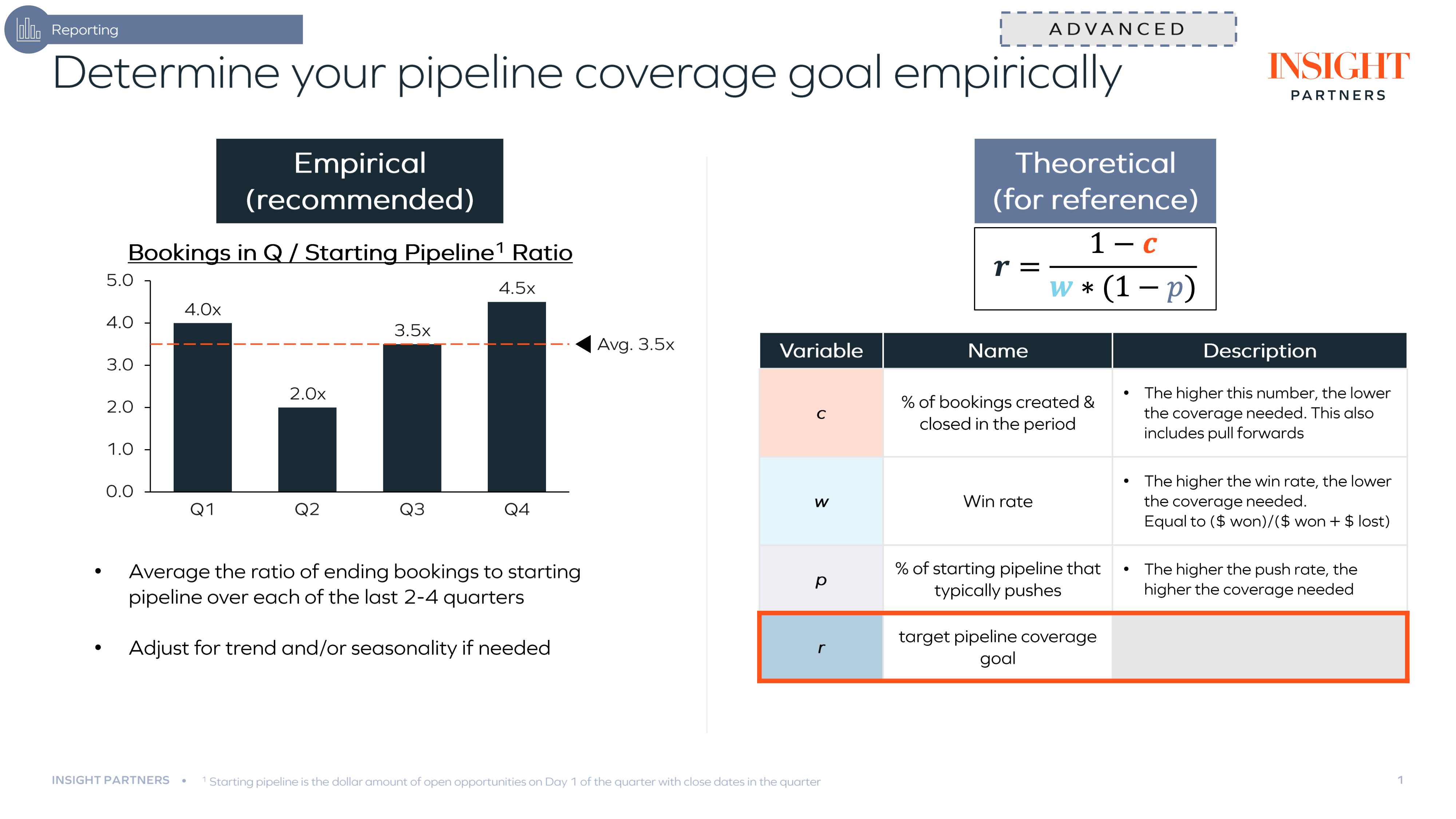
If you’d like to take a deeper dive on this topic with recommendations on how to calculate this for yourself, check out How Much Pipeline Coverage Do You Need.
Now we know how to measure whether we have “enough” pipeline with pipeline coverage. There’s one problem. Pipeline coverage is a forward-looking metric for revenue generated in a given quarter, but it’s a backwards-looking metric for our resolution. The question then shifts to: “What can we do this quarter to ensure we start next quarter with the right pipeline coverage?”
For most sales teams, a big chunk of the answer comes in the form of inbound. Since that’s owned by marketing it’s rarely under the sales team’s direct control.
One thing that is under sales’ control is outbound. The problem is they don’t control it very well. Most outbound teams focus on activity, operating on the principle that more activity = more pipeline2.
Reps typically get a patch, get told they’re “the CEO of their territory” and get sent off to make their fortunes. Any problems? Just do more activity! How many times have you heard (or said) some variation of, “It takes 100 dials to set a meeting. Every no gets you closer to that yes!”
In 2026, sales teams should resolve to get more sophisticated about outbound so they can control their pipeline destiny. That means moving beyond brute force activity towards a more sophisticated picture of how activity translates into pipeline creation. That means paying attention to some different metrics:
Account Coverage - to see whether the team is working the right accounts
Opportunity Creation Rate - to see the percentage of engaged accounts that turn into opportunities
Incubation Period - to see how long it takes an account to go from outbound touch to opportunity
That also means changing how they work accounts, which we’ll see in the second resolution.
Further reading:
Resolution 2: Focus on fit first, signals second
Approximately nobody enjoys doing cold outbound. Ideally reps would have a reason to reach out—even better if it’s something that indicates a buyer might be interested right now.
In 2025, everyone obsessed over signals. My LinkedIn feed was alive with GTM Engineers pushing the idea of AI continuously scraping the internet for signs of a prospect with a pulse and then routing them to a rep (or better yet, an AI agent) ready to pounce.
Meanwhile, my Gmail inbox was alive with… this:

There’s nothing inherently wrong with signals. In fact, you’d be stupid not to use them. However, too many sales teams forget that fit comes first. There’s no point in chasing signals for accounts that aren’t in your ICP. I’ve always viewed this through the lens of the Fit-Timing (FT) Quadrant:

Ideally, every bit of outbound energy should be focused on the top-right quadrant where great fit buyers are ready to buy. If you relax the fit criteria and rely too much on signals, you’ll end up creating a lot of ephemeral pipeline from folks in the bottom right. This is the land of slow-nos and happy ears.
In 2026, every revenue team should re-dedicate themselves to being fit-first before chasing down any signals.
Take the first few weeks of the year and really dig into your ICP. Enrich your data and use the scoring methods that Grant Hefler from SBI discusses in our Secrets of Segmentation chat. If you don’t have a bunch of historical data, use a rules-based approach that gives a basic, explainable, starting point.
Don’t worry about perfection. As a reminder, here’s my Uncharted Territory Law of Account Scoring:
The best account score is the one reps actually use so long as it’s better than choosing accounts at random.
Once you’ve got that score, operationalize it. You can’t just assume your reps will go after the highest scoring accounts on their own—they absolutely will not. The best approach is to build focus into your account coverage model. Use territory design to drive rep behavior and coaching to hold them accountable.
Further reading:
Resolution 3: Move from AI experiments to real efficiency
ChatGPT launched on November 30th, 2022. We’re already in year 4 of the LLM era. Time flies when you’re setting money on fire.
The problems with early LLM models—hallucinations, poor instruction following, limited context—still exist. However, the most recent models are lightyears better in all these areas.
I believe we’ve recently3 reached a tipping point in model capabilities. They’re not perfect. But guess who else makes mistakes, doesn’t always follow instructions and gets a little lost when they have to remember a bunch of stuff? People. These models are on par with all but the most experienced employees in many domains.
We’ve seen this evolution ourselves building the Carve territory agent. GPT 5.2 can do very sophisticated analysis and code generation. With the right context, tools and engineering around it, it’s as good as any RevOps analyst for this task.
There just aren’t any more excuses for slow-rolling AI usage. 2026 is the year you should be seeing real efficiency gains from AI in production.
This was the theme of my talk with Kristina McMillan at Scale Venture Partners. Based on Scale’s survey of 300 GTM leaders, it’s clear teams are beginning to use AI to radically augment rep performance, not just improve things at the margins:
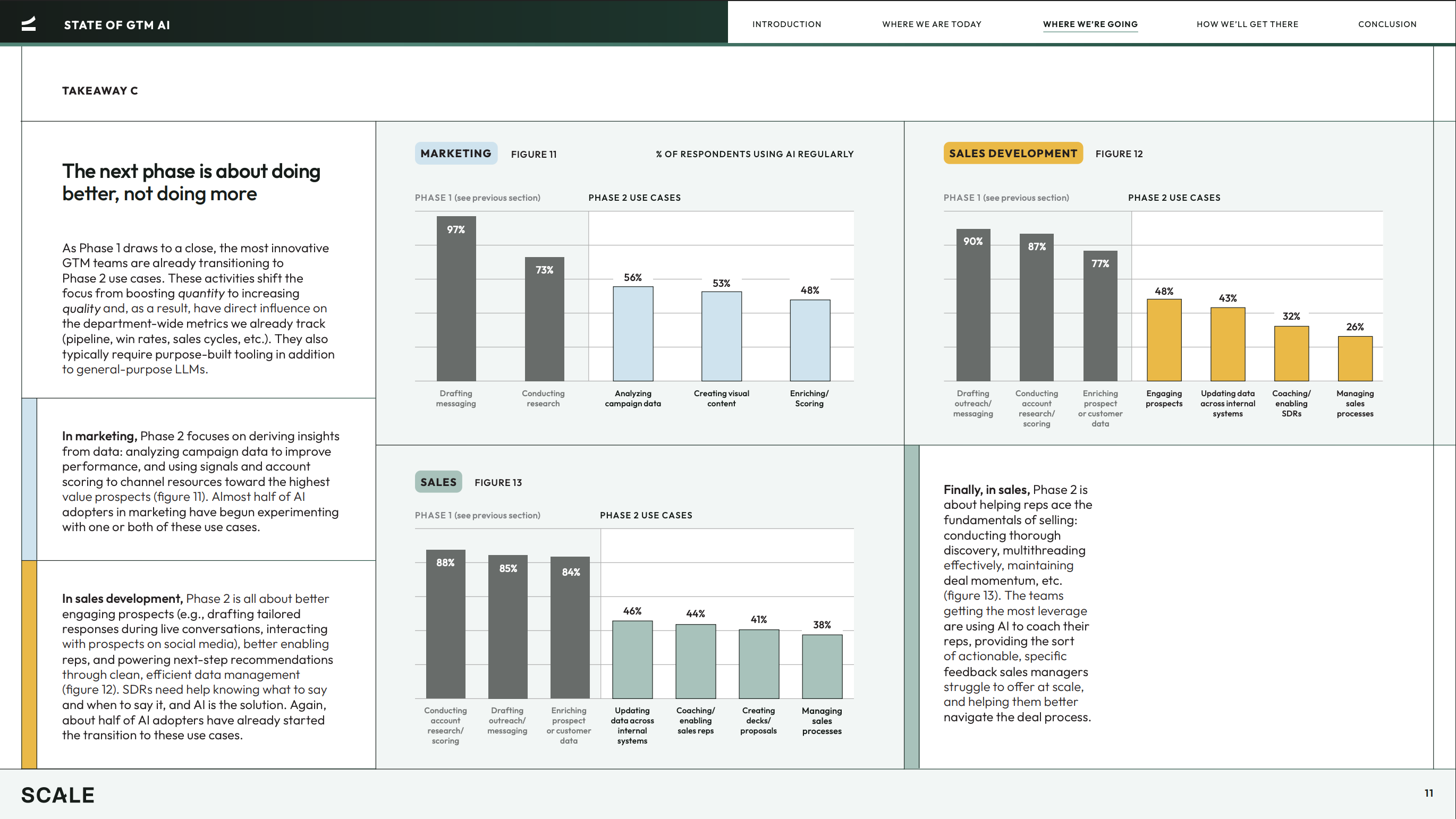
We’re not going to hit 10x Rep levels in 2026, but it’s time to make material steps in that direction. The potential CAC improvements will be massive because large sales teams are historically expensive.
I’d love to give you sage advice from experience but I can’t do that for this one. Besides our own tools, we don’t deploy a ton of AI in our GTM at Gradient Works. I plan to follow this resolution and change that. We’ll need to solve two big problems:
Focus - Avoid the temptation to sprinkle a little AI here and there. My goal will be to identify a single process and implement it end-to-end. Go deep or go home.
Context - Even for a small team like ours, it’s hard to gather all the information we need for an end-to-end AI use case all into one place that’s accessible to AI. We’re making progress on a data warehouse as we speak. That should help.
I suspect these will be problems for other teams as well. I’ll report back on our experience.
Further reading:
Wrapping Up
There you have it. Start each quarter with enough pipeline. Get that pipeline by being ruthless about prospect fit. Drive efficiency with AI (which is really and truly finally ready). I’m confident if we all keep to those resolutions for the whole year, it’ll be a good one.
Miracles are notoriously hard to forecast.
This isn’t always wrong, but it’s definitely not very efficient.
And I do mean relatively recently. Gemini 3 and GPT 5.2 came out in November and December of 2025, respectively.